
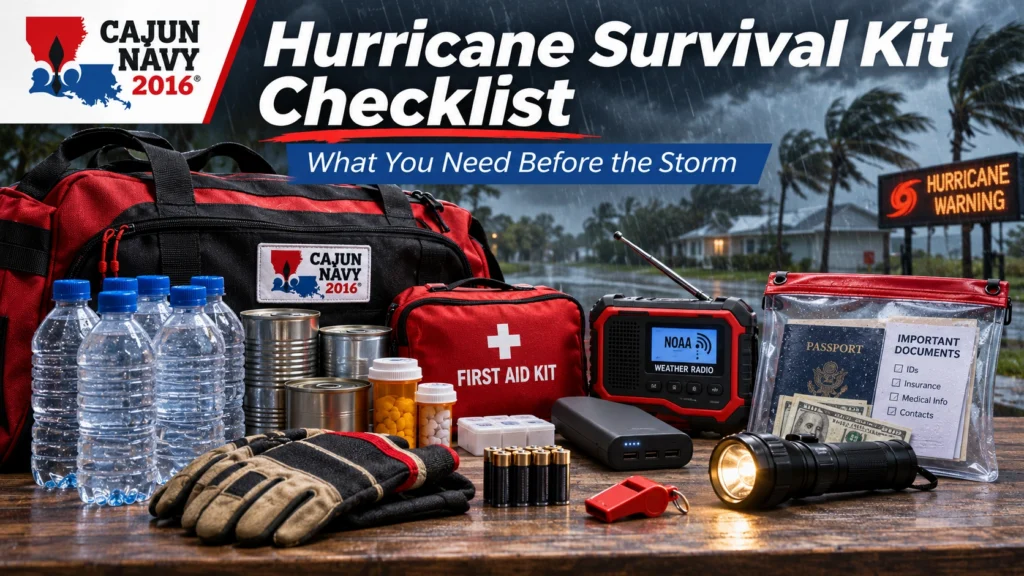

When a hurricane is bearing down on your town, you don’t have time to figure out what to pack. You need a bag by the door that’s already done — or a closet full of supplies that’ll keep your family alive for two weeks without power, running water, or a grocery store.
We know this because we’ve seen what happens when people aren’t ready. At Cajun Navy 2016, we’ve responded to Hurricanes Harvey, Ida, Sally, and Helene. We’ve pulled more than 50,000 people out of floodwater across Louisiana, Texas, Mississippi, Florida, and North Carolina. We’ve handed water to families who had none. We’ve watched people break down because they left their medications on the kitchen counter.
Most hurricane kit lists online are written by product companies trying to sell you gear or by writers who’ve never been anywhere near a hurricane. This one comes from the people who show up after the storm hits. Every item on this list is here because we’ve seen someone desperately need it — or desperately wish they’d packed it.
Why This List Is Different: What 50,000+ Rescues Taught Us
When our swift-water rescue teams reach a family during a hurricane, the difference between a prepared household and an unprepared one is visible within seconds.
Prepared families have water. They have their medications. They have their documents in a waterproof bag. They have shoes on. They can tell us who they are, what they need, and where they’re going.
Unprepared families are standing in floodwater in bare feet. They can’t find their medication. They don’t have ID — which means registering for FEMA assistance becomes a nightmare. They have nothing to eat and no way to charge a phone to reach family members.
The items on this list aren’t theoretical. Every single one of them comes from what we’ve seen work in the field — and what we’ve seen people desperately wish they’d packed.
Part 1: The 72-Hour Evacuation Go-Bag
If authorities issue an evacuation order, you need to leave fast. Your go-bag is a single bag — a duffel, backpack, or bright-colored waterproof bag — packed and stored near your front door, ready to grab in under two minutes.
Choose a brightly colored bag (yellow, orange, or red). We’ve spotted people in flooded areas faster because their bag was visible from a rescue boat. A black bag in brown floodwater is invisible.
Water and Hydration
- One gallon of water per person per day for three days. That’s three gallons per person — a family of four needs 12 gallons minimum.
- Half a gallon per day for each pet. Your dog needs water too — don’t forget them.
- Water purification tablets or a bottle of plain household bleach (unscented, 8.25% sodium hypochlorite). If your stored water runs out, you can treat rainwater or tap water you’re not sure about: 8 drops of bleach per gallon, shake it, and wait 30 minutes. This won’t make floodwater safe — floodwater is full of sewage, chemicals, and debris — but it works on collected rainwater.
- Collapsible water containers or empty bottles you can fill before the storm hits. Here’s a trick: freeze water bottles ahead of time. They keep food cold in your cooler, and as they melt, you’ve got cold drinking water.
- Electrolyte packets. People forget this one. In Gulf Coast heat — especially when you’re stressed, sweating, and hauling belongings — plain water isn’t always enough. Dehydration sneaks up on you fast.
Food and Cooking Supplies
- Three-day supply of non-perishable food per person. Focus on calorie density and foods that require no cooking or refrigeration.
- Best options: Canned meats (tuna, chicken, Vienna sausages), canned fruits and vegetables, peanut butter, crackers, granola bars, energy bars, trail mix, dried fruit, nuts, cereal, hard candy, and MREs (Meals Ready to Eat) if you can get them.
- Manual can opener. You’d be amazed how many people pack a bag full of canned food and forget the one thing that opens them. Don’t be that person.
- Disposable plates, cups, utensils, and paper towels. There’s no running water to wash dishes — don’t even think about it.
- A small camp stove or Sterno cans with matches if you have room. If not, pack food that’s ready to eat straight from the can.
Field note: After Hurricane Ida, some families went 10+ days without power. The ones who’d stocked calorie-dense foods like peanut butter and trail mix fared far better than families who’d packed only canned soup — which is mostly water and low in calories.
First Aid and Medications
- A complete first aid kit: Adhesive bandages (assorted sizes), sterile gauze pads, adhesive tape, antibiotic ointment, antiseptic wipes, pain relievers (ibuprofen and acetaminophen), anti-diarrheal medication, antacids, cold pack, tweezers, small scissors, non-latex gloves, and a CPR guide.
- At least a 7-day supply of all prescription medications. Ask your doctor for an emergency refill if your supply is low before hurricane season. Some insurance plans allow a 90-day supply for emergencies.
- Over-the-counter essentials: Allergy medicine, anti-itch cream (insect bites become a major problem after flooding), anti-nausea medication, and rehydration salts.
- Personal medical items: Glasses and/or contact lenses with solution, hearing aids with extra batteries, insulin with a small cooler and chemical ice packs (insulin cannot survive Gulf Coast heat without cooling), inhalers, epinephrine auto-injectors, blood pressure cuffs, or any medical device you depend on daily.
- Insect repellent. Nobody’s thinking about mosquitoes when a hurricane is coming. But two days after the storm, when every ditch and yard is full of standing water, the mosquitoes show up in swarms. This isn’t just annoying — it’s a real disease risk.
- Sunscreen (SPF 30+). You’re going to be outside more than you think — clearing debris, tarping the roof, waiting in lines. A bad sunburn on top of everything else makes dehydration and heat exhaustion worse.
Field note: We cannot stress this enough — bring your medications. In rescue after rescue, the most urgent non-life-threatening need we encounter is people who left their medications behind. Pharmacies are closed. Roads are impassable. The nearest open pharmacy may be hours away.
Electronics, Power, and Communication
- Battery-powered or hand-crank NOAA Weather Radio with tone alerts. This is non-negotiable. When cell towers go down and the internet dies, NOAA radio is the only way to receive official storm updates, evacuation orders, and rescue coordination information. Buy one that also has a flashlight and USB phone-charging port built in — they cost $25–$40 and are worth every penny.
- Heavy-duty flashlight or headlamp with extra batteries. A headlamp is better for hands-free work in the dark. Pack at least two sets of extra batteries in a waterproof bag.
- Portable power bank (fully charged). A 20,000 mAh power bank can charge a smartphone 4–5 times. Charge it fully before the storm. A solar-powered charger is a smart backup if you expect extended outages.
- Car charger for your phone. Your car’s battery may be the only power source you have for days — but never run your car in a closed garage.
- Phone charging cables for every device type your family uses.
- A physical contact list. Write down — on paper — the phone numbers of every family member, your insurance company, your doctor, your employer, and FEMA’s helpline (1-800-621-3362). When your phone dies, you can’t look up numbers you’ve stored only digitally.
Important Documents and Cash
- Waterproof document pouch or zip-lock bag containing: Photo IDs (driver’s license, passport) for every family member, health insurance cards and policy numbers, homeowner’s or renter’s insurance policy with your agent’s contact info, birth certificates, Social Security cards, bank account information, vehicle registration and titles, mortgage or lease documents, and a printed list of all prescription medications with dosages.
- Cash in small bills: at least $200–$500. When the power grid fails, ATMs don’t work. Card readers don’t work. Gas stations that run on generators are cash-only. Stores that open after the storm are cash-only. Carry mostly $1s, $5s, $10s, and $20s — making change is difficult when registers are down.
- Digital backup: Store copies of all documents on a USB drive and in a cloud service (Google Drive, iCloud, Dropbox). If your physical copies are destroyed, the digital versions let you start the recovery process.
- Photos of your home, vehicles, and valuable possessions taken before the storm. These are critical for insurance claims. Walk through every room and record a video. Upload it to the cloud before the storm arrives.
Clothing and Shelter Basics
- One complete change of weather-appropriate clothing per person: Long-sleeved shirt, long pants, underwear, and socks.
- Sturdy, closed-toe shoes. After a hurricane, the ground is covered with nails, glass, splintered wood, and debris. Flip-flops and sandals lead to foot injuries, which in contaminated floodwater can lead to dangerous infections. Check our water safety tips — we’ve treated more cut feet than almost any other injury.
- Rain gear: A waterproof poncho or rain jacket. A heavy-duty trash bag works in an emergency — cut holes for your head and arms.
- Emergency Mylar blankets or sleeping bags (one per person). Even in warm climates, being wet and exposed to wind at night causes hypothermia faster than people expect.
- Hat for sun and rain protection.
- Work gloves. Essential for handling debris during and after the storm.
Part 2: The 14-Day Shelter-in-Place Kit
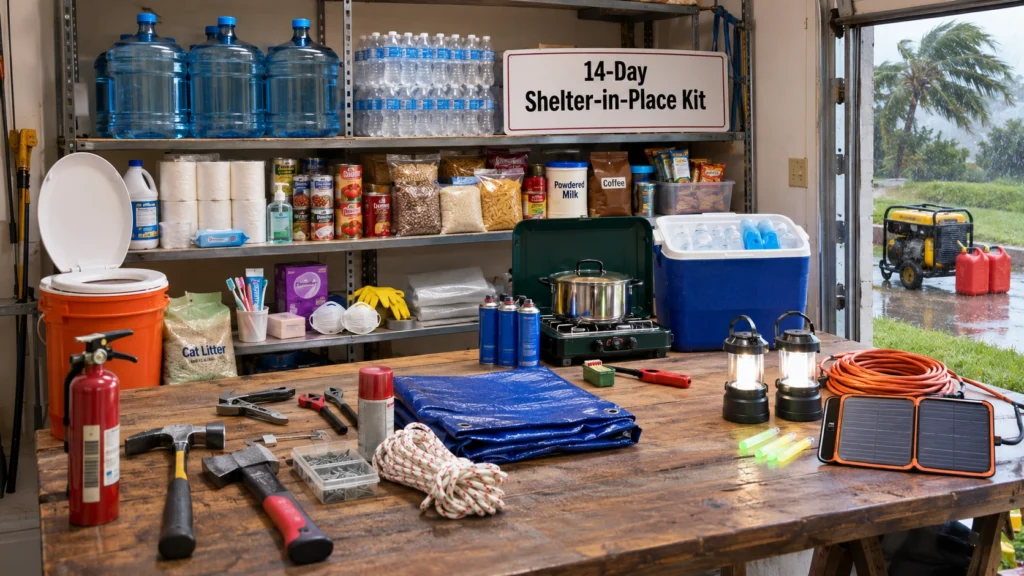
If you choose to ride out the storm at home or if evacuation isn’t possible — you need supplies for up to two weeks without electricity, running water, or access to stores.
This kit stays in your home. It’s separate from your go-bag.
Extended Water and Food Supply
- One gallon of water per person per day for 14 days. A family of four needs 56 gallons. That’s a lot of water — start buying and storing now, not when a storm is announced.
- Store water in food-grade containers. Clean 2-liter soda bottles work well. Never use milk jugs — they’re difficult to fully sanitize and degrade quickly. Rotate stored water every six months.
- 14 days of non-perishable food per person. In addition to the canned goods and energy bars listed above, stock rice, pasta, dried beans, powdered milk, instant coffee, and comfort foods (candy, cookies, popcorn — morale matters during a two-week outage).
- A camping stove, butane stove, or propane grill with fuel. Never use any fuel-burning stove or grill indoors — carbon monoxide poisoning is the number one post-hurricane killer that is entirely preventable.
- A large cooler with ice. Fill it before the storm hits. Frozen water bottles serve as ice and become drinking water when they melt.
- Waterproof matches or a butane lighter.
Sanitation and Hygiene — The Section Nobody Writes About
Here’s the truth most hurricane kit lists skip: when your water stops and your toilets don’t flush, sanitation becomes an immediate crisis. After day two without sanitation, disease risk rises dramatically. This is not optional — it’s survival.
- A 5-gallon bucket with a snap-on toilet seat lid (or use a pool noodle cut to fit). This is your toilet for as long as the plumbing is out.
- Heavy-duty trash bags (plenty of them) as bucket liners. Double-bag.
- Cat litter, sawdust, or commercial waste solidifier to pour into the bucket after each use — it controls odor, absorbs liquid, and reduces disease risk.
- Toilet paper.
- Hand sanitizer (at least 60% alcohol).
- Antibacterial wipes and/or baby wipes for personal hygiene when you can’t shower.
- Bar soap and liquid dish soap.
- Toothbrushes and toothpaste.
- Feminine hygiene products.
- Household bleach (unscented): Use for water purification (8 drops per gallon), surface disinfection (1 part bleach to 9 parts water), and mold prevention.
- Rubber gloves and N95 masks — essential for mold cleanup and handling contaminated flood debris.
- Plastic sheeting and duct tape for covering broken windows or creating a sealed room.
Field note: Mold begins growing on wet surfaces within 24–48 hours in Gulf Coast humidity. If your home floods even a few inches, you need bleach, gloves, masks, and trash bags to begin remediation immediately. Families who wait for professional help can wait weeks — and by then, the mold has spread through walls and flooring.
Tools, Safety, and Home Protection
- Multi-tool (Leatherman-style) with pliers, knife, screwdrivers, and can opener.
- Wrench or pliers for shutting off gas and water valves. Know where your shutoff valves are before the storm.
- ABC-rated fire extinguisher.
- Hammer, nails, plywood, and screws for boarding windows or making emergency repairs.
- Tarps (at least two large ones) for covering roof damage and protecting exposed areas from further rain.
- Chainsaw or hand saw for clearing fallen trees from driveways, doorways, and access routes.
- Rope (50 feet minimum).
- Spray paint for marking your home with your name and a status message if you evacuate (first responders look for these marks).
- Axe or hatchet. If floodwater traps you on a lower floor and water keeps rising, you may need to break through to an attic or roof. During Hurricane Katrina, rescue teams found families who’d retreated to attics with no way to get out when water followed them up. An axe saved lives.
Power and Cooking Without Utilities
- A portable generator if you can afford one. Run it outdoors only — never in a garage, carport, shed, or inside your home, even with windows open. Place it at least 20 feet from doors and windows. Carbon monoxide from generators killed more people after Hurricane Laura than the storm itself did.
- Heavy-duty extension cords (outdoor-rated) to run from the generator to inside appliances.
- Fuel for the generator stored in approved containers, away from the house. Add fuel stabilizer to prevent degradation. Store no more than 25 gallons.
- Solar charger or solar panel kit as a silent, fume-free alternative for keeping phones and radios charged.
- LED lanterns (battery-powered). Do not use candles — they’re a fire hazard, especially in homes with gas leaks or fuel vapors after a storm.
- Glow sticks for safe nighttime navigation, especially in hallways and bathrooms.
Special Kits: Babies, Elderly, Disabled Family Members, and Pets
Standard kit lists assume healthy adults. If your household includes anyone with specialized needs, these additions can be life-or-death.
Babies and Toddlers
- Formula, bottles, and nipples for at least 7 days (14 if sheltering in place)
- Baby food and infant cereal
- Diapers and wipes for at least 7–14 days
- Diaper rash cream
- Infant medications (fever reducer, gas drops)
- Pacifiers and comfort items (a familiar blanket or stuffed animal)
- A portable crib or pack-and-play if you’re evacuating
- Extra clothing — babies go through outfits fast
Elderly Family Members
- All prescription medications in clearly labeled containers with dosage instructions
- A backup mobility device (cane, walker, or lightweight wheelchair)
- Extra hearing aid batteries (several packs — they drain faster than people expect)
- A laminated card with the person’s name, medical conditions, medications, allergies, emergency contacts, and doctor’s name and number. Attach it to their person.
- Adult incontinence products if needed
- Non-slip shoes
- A plan for air conditioning — heat exposure is the number one risk for elderly family members during a power outage. Know the nearest cooling shelter location.
Disabled Family Members
- Battery backup for any power-dependent medical equipment (CPAP machines, oxygen concentrators, powered wheelchairs, nebulizers). Know exactly how many hours your backup batteries last.
- A laminated communication card with useful phrases if the person is non-verbal or has communication challenges
- Sensory comfort items for individuals with autism or sensory processing needs
- Extra supplies for feeding tubes, catheters, or other medical devices
- Contact your power company to register as a priority restoration customer if anyone in your household depends on electric medical equipment
Pets
- Food and water for 7–14 days stored in airtight, waterproof containers
- Medications in a waterproof container
- Collar with current ID tag, rabies tag, and your cell phone number. If your pet gets separated from you during evacuation, this is how you get them back.
- Microchip your pet before hurricane season and make sure the registration is current. Our missing persons response team has seen how quickly pets get separated from families in a storm — a microchip is the fastest way to reunite.
- A sturdy leash, harness, and a carrier or crate (one per pet)
- Pet first aid kit (ask your veterinarian what to include)
- A recent photo of you with your pet — this proves ownership if you’re separated
- Litter, litter box, newspaper, paper towels, and trash bags for sanitation
- Comfort items: A familiar toy, blanket, or treat
- Vaccination records and vet contact information
Important: Most public emergency shelters do not accept pets. Research pet-friendly shelters, hotels, and veterinary clinics on your evacuation route before storm season. Have at least two options identified.
9 Items Most People Forget (That Rescuers Wish They Hadn’t)
After thousands of rescues, these are the items we see missing again and again:
- Photo ID. Without it, registering for FEMA disaster assistance is significantly harder. Pack copies in your go-bag and upload digital copies to the cloud.
- Cash in small bills. Everyone remembers to grab their wallet. Almost nobody has actual cash. ATMs are down. Card readers are down. You need physical money.
- Prescription medications. People grab clothes and phones. They leave their pill bottles on the nightstand. This becomes a medical emergency within 24–48 hours for people on blood pressure medication, insulin, anti-seizure drugs, or blood thinners.
- Sturdy shoes. We’ve rescued people barefoot more times than we can count. The ground after a hurricane is a minefield of nails, glass, and sharp metal. One cut foot in contaminated floodwater can lead to a serious infection.
- A whistle. If you’re trapped in an attic, under debris, or waving from a rooftop, your voice gives out in minutes. A whistle carries farther and lasts longer. We’ve located people because of a whistle when we couldn’t hear their voices.
- Glasses or contacts. People who wear corrective lenses frequently forget to pack a spare pair. You need to see clearly to navigate flooded roads, read evacuation signs, and assess damage safely.
- Bug spray. Nobody thinks about mosquitoes when a Category 4 hurricane is approaching. But 48 hours after the storm, with standing water everywhere, mosquitoes breed in massive numbers. West Nile virus, Eastern equine encephalitis, and Zika are real risks in standing floodwater zones.
- Entertainment for kids (and adults). This sounds minor until you’re on day four without power, internet, or television. Boredom accelerates anxiety and makes a hard situation unbearable. Pack books, playing cards, coloring books, board games, and journals. They cost nothing and matter more than people realize.
- Spare car and house keys. If you evacuate and your main keys are lost in floodwater, you can’t get back into your house or start your car. Pack spares in your go-bag.
What the First 72 Hours After a Hurricane Really Look Like
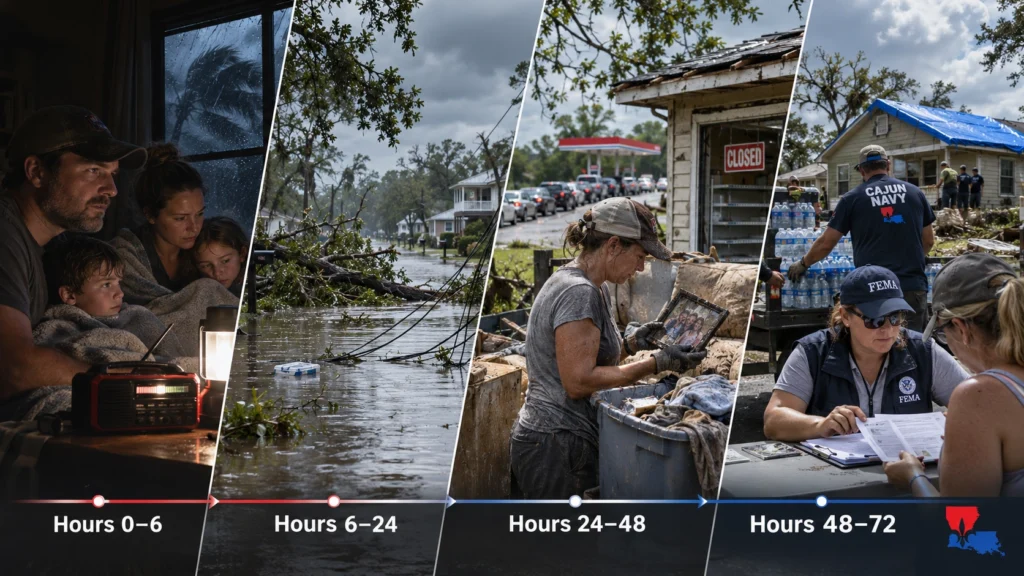
Most kit lists tell you what to pack. Almost none tell you what you’re packing for. Here’s the reality, based on what our teams see in the field:
Hours 0–6 (During the storm): You’re sheltered — in your home, a shelter, or your vehicle. Wind, rain, and storm surge are the immediate threats. Power goes out. Cell service becomes spotty, then fails. The NOAA weather radio is your only reliable information source.
Hours 6–24 (Immediate aftermath): The wind stops but the danger doesn’t. Know the difference between a flood watch and a flood warning — because floodwater is still rising in many areas. Downed power lines are live and hidden under water. Roads are blocked by trees, debris, and standing water. Emergency services are overwhelmed and cannot reach most neighborhoods. You are on your own.
Hours 24–48: The scope of the damage becomes clear. Grocery stores are closed — and when they open, shelves are stripped within hours. Gas stations are either closed or have lines stretching for miles. If your home is damaged, you’re beginning to assess what can be saved. Mold is already starting on anything that got wet. The heat — especially on the Gulf Coast in August and September — is brutal without air conditioning.
Hours 48–72: Relief organizations (including us) are arriving in force — here’s how our hurricane response works — but reaching every affected neighborhood takes days. FEMA registration opens, and the lines — physical or digital — are long. If you don’t have ID and insurance documentation, the process stalls. Mosquitoes have arrived. If you haven’t secured your roof with tarps, further rain will compound the damage.
This is what your kit is for. Not a theoretical scenario — a Tuesday afternoon in August on the Gulf Coast. If you want to understand the stages of a hurricane and what each one means for your family, we’ve written about that too.
Hurricane Kit Mistakes That Can Kill You
Some of the most common preparation mistakes don’t just cause inconvenience — they’re genuinely dangerous.
Running a generator indoors or in a garage. Carbon monoxide is odorless and colorless. During Hurricane Laura (2020), more people died from generator-related carbon monoxide poisoning in the aftermath than from the storm itself. Run generators outdoors, at least 20 feet from any door or window, with the exhaust pointing away from the house.
Using candles for lighting. After a hurricane, gas leaks from damaged lines are common. One candle near a gas leak causes an explosion. Use battery-powered LED lanterns, flashlights, and glow sticks. No open flames.
Driving through floodwater. Six inches of fast-moving water can knock you off your feet. Twelve inches can carry away a small car. Two feet of water will float most vehicles, including SUVs and trucks. “Turn around, don’t drown” isn’t a slogan — it’s the single most important survival rule during and after a hurricane. We’ve pulled more people from flooded vehicles than from flooded homes.
Drinking or wading through floodwater without protection. Floodwater is not just rainwater. It contains sewage, agricultural runoff, industrial chemicals, gasoline, pesticides, and animal waste. Skin contact can cause rashes and infections. Swallowing it causes severe gastrointestinal illness. If you must wade through it, wear rubber boots and waterproof gloves, and wash thoroughly with clean water and soap as soon as possible.
Waiting until a storm is announced to build your kit. This ties into everything we teach about staying safe during hurricane season. When a hurricane enters the Gulf, stores are overwhelmed within hours. Water sells out first, then batteries, then canned food. By the time a hurricane watch is issued, the supplies you need are already gone. Build your kit during the off-season and maintain it year-round.
How to Maintain Your Kit Year-Round
A hurricane kit that sits in a closet for three years isn’t a kit — it’s a box of expired food and dead batteries. Here’s what keeps yours actually ready when you need it:
Every 6 months (January and July):
- Check expiration dates on all food items. Replace anything within 3 months of expiring.
- Rotate stored water. Empty and refill water containers.
- Test all flashlights, radios, and electronic devices. Replace batteries.
- Check that medications haven’t expired. Refill prescriptions if needed.
- Test your NOAA weather radio.
Every year (May — before hurricane season):
- Update all documents: insurance policies, medication lists, emergency contact numbers, and IDs.
- Take updated photos/video of your home and possessions for insurance documentation.
- Replace the breakaway battery if you have a boat trailer with electric brakes.
- Verify evacuation routes — road construction or community changes may have altered them.
- Confirm pet-friendly shelter options are still available.
- Update pet ID tags with current phone numbers.
- Restock sunscreen, insect repellent, and any hygiene items that have been used.
- Check your generator: run it for 15 minutes, verify oil level, and confirm fuel supply.
When a storm enters the Gulf:
- Fill all vehicles with gas immediately.
- Fill bathtubs with water for flushing toilets and cleaning.
- Freeze water bottles and fill coolers.
- Charge every device: phones, power banks, laptops, radios.
- Withdraw cash ($200–$500 in small bills).
- Move your go-bag to the front door.
- Photograph/video your home and upload to the cloud.
Printable Hurricane Survival Kit Checklist
72-Hour Go-Bag
| Category | Items |
| Water | 1 gallon/person/day × 3 days, pet water, purification tablets/bleach, electrolyte packets |
| Food | 3-day supply of non-perishables, manual can opener, disposable utensils, camp stove (optional) |
| First Aid | Complete first aid kit, 7+ day prescription meds, OTC medicines, insect repellent, sunscreen |
| Medical | Glasses/contacts, hearing aid batteries, insulin + cooler, inhalers, any medical devices |
| Power/Comms | NOAA weather radio, flashlight/headlamp, extra batteries, power bank, car charger, charging cables |
| Documents | Waterproof pouch: IDs, insurance, birth certificates, bank info, medication list, contacts on paper |
| Cash | $200–$500 in small bills ($1s, $5s, $10s, $20s) |
| Clothing | Full change of clothes, sturdy shoes, rain gear, work gloves, hat, emergency blankets |
| Sanitation | Hand sanitizer, wipes, feminine products, trash bags, toilet paper |
| Safety | Whistle, dust mask, multi-tool, spare keys, local maps |
| Special Needs | Baby supplies, elderly meds/mobility aids, pet supplies, comfort items |
| Morale | Books, cards, games, journal, coloring books for kids |
14-Day Shelter-in-Place Additions
| Category | Items |
| Water | 1 gallon/person/day × 14 days, water storage containers |
| Food | 14-day supply including rice, pasta, dried beans, comfort food |
| Cooking | Camp stove + fuel, cooler + ice, waterproof matches/lighter |
| Sanitation | 5-gallon bucket + toilet seat lid, cat litter, heavy-duty trash bags, bleach, rubber gloves, N95 masks |
| Tools | Hammer, nails, plywood, tarps, chainsaw/hand saw, rope, axe, spray paint, wrench for utilities |
| Power | Generator (outdoor use ONLY, 20+ feet from house), fuel + stabilizer, extension cords, solar charger, LED lanterns, glow sticks |
FAQ
How much water do I need for a hurricane kit?
Plan on one gallon per person per day — that covers drinking and basic hygiene. If you’re evacuating with a go-bag, that’s 3 gallons per person for 72 hours. If you’re staying home and riding it out, you need 14 gallons per person. Do the math for your family — a household of four sheltering in place needs 56 gallons. That sounds like a lot because it is. Don’t forget your pets either — half a gallon per day each. And if anyone in your home is nursing, sick, or very young, they’ll likely need more than a gallon a day.
How long should a hurricane kit last?
The official answer is 72 hours. The honest answer? That’s barely enough if you’re evacuating. If you’re staying home, plan for 14 days. We’ve seen neighborhoods go three weeks without power after Katrina and Ida. No electricity, no running water, no open stores. Three days of supplies runs out fast when you’re living through that.
What is the most important item in a hurricane kit?
Water — and it’s not even close. You can go weeks without food if you have to. Without water, especially in Gulf Coast heat, you’re in serious trouble within a day or two. After water, the answer is your prescription medications. We can’t tell you how many times we’ve reached a family and the first thing they say is “I left my pills at home.” That turns into a medical emergency fast when pharmacies are closed and roads are impassable.
Should I buy a pre-made hurricane kit?
They’re fine as a starting point — but don’t trust one to actually keep you safe on its own. Most pre-made kits come with basic first aid, a small flashlight, and maybe a day’s worth of food and water for one person. That’s it. They never include enough water, your medications, cash, your documents, sanitation supplies, or anything for your kids or pets. Buy one if it makes you feel like you’re getting a head start, but then build on top of it with everything on this checklist.
When should I prepare my hurricane kit?
If you’re reading this article, today. Seriously — don’t wait until a storm is in the Gulf. Don’t wait for a hurricane watch. The moment a storm shows up on the news, everyone rushes to the same stores at the same time. Water sells out first. Then batteries. Then canned food. By the time a watch is issued, the shelves are empty and you’re out of luck. Build your kit in the off-season — December through April — when everything is available and cheap. Then keep it maintained year-round with the schedule above.
What should I do with my hurricane kit if I evacuate?
Grab your 72-hour go-bag and go. Leave your 14-day shelter-in-place supplies at home — but move them somewhere high and dry before you leave, in case the house floods. When you come back after the storm, those supplies will be waiting for you. And you’ll probably need them, because power and water often aren’t restored for days or even weeks after they let residents return.