
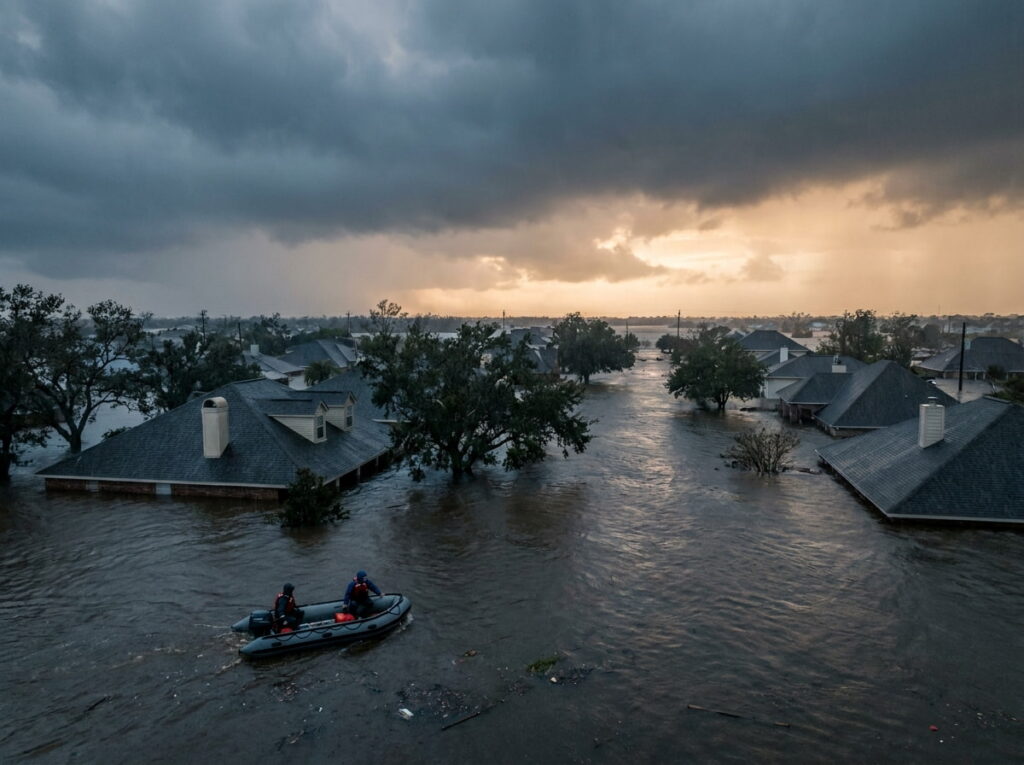

A storm surge is a sudden, abnormal rise in seawater caused by a storm’s powerful winds pushing ocean water toward the shore. It is not a wave. It is not rain. It is the ocean itself, moving inland, and it can happen faster than most people can escape.
Here at Cajun Navy 2016, we have seen what storm surge does to real communities. We were in the water in 2016 when Louisiana flooded. We were there after Hurricane Katrina ravaged the Gulf Coast. We have pulled people off rooftops, out of cars, and away from rising walls of dark, filthy water. When people ask us what a storm surge is, we do not just give a textbook answer. We give the honest one:
Storm surge is the number one cause of hurricane deaths in the United States. And most people still do not take it seriously enough.
This guide will explain everything you need to know: what storm surge means, how it works, why it is so dangerous, and what you should do if a storm surge warning is issued in your area.
Storm Surge Definition: What Does Storm Surge Mean?
The storm surge definition is straightforward: it is the rise in sea level that a storm creates over and above the normal, predicted tide. Think of it like this: imagine the ocean is a bowl of water. When a hurricane passes over it, the storm acts like a giant hand pushing that water toward the edge. Wherever the “edge” is (your coastline, your town, your neighborhood) the water piles up and overflows.
Storm surge is measured in feet above the normal high tide. A surge of 5 feet means the water is 5 feet higher than it should be. A surge of 20 feet means the entire first and second floor of a typical home could be underwater.
People sometimes confuse storm surge with storm tide. Here is the difference:
- Storm surge = the rise in water caused only by the storm
- Storm tide = the total water level = storm surge + the regular astronomical tide
- Inundation = how far the water actually rises above dry ground (the number that matters for your house)
If a storm surge hits during high tide, the combined effect creates a storm tide that can be dramatically higher than either number alone. This is why storms that make landfall at high tide are often so much more catastrophic.
What Causes a Storm Surge?
Most people think the wind is the most dangerous part of a hurricane. The wind is loud. The wind makes the news. But it is actually the water that kills.
Storm surge happens because of two main forces working together:
1. Wind-Driven Water (The Main Cause)
As a hurricane spins over the ocean, its rotating winds create enormous friction on the water’s surface. This literally pushes a massive mound of water toward the coastline. The stronger the winds, the bigger the mound. As the storm gets closer to shore, that water has nowhere to go except onto land.
2. Low Atmospheric Pressure (A Contributing Factor)
At the center of a hurricane, air pressure is extremely low. This creates a slight “dome” effect, where the ocean surface actually rises beneath the storm’s eye, almost like the storm is sucking the water upward. This usually accounts for about 5% of the total surge.
Other Factors That Make Storm Surges Worse
Beyond these two drivers, several other things influence how bad a storm surge gets:
Storm intensity and size. Larger storms with higher wind speeds push more water. A Category 4 or 5 storm creates far more surge than a Category 1 — but size matters too. A compact storm might have higher winds; a massive storm might push water over a much larger area.
Angle of approach. A hurricane that hits the coast head-on creates the worst surge. One that travels at an angle to the coastline loses some of its pushing effect.
Coastal shape. This one surprises people. Bays, inlets, and estuaries act like funnels. When water is pushed into a narrowing channel like the mouth of a river or the inside of a bay — the surge height is amplified significantly. Wide, open coastlines tend to see the water spread out more. Louisiana’s coastline, with all its bayous, waterways, and low-lying wetlands, is particularly vulnerable for exactly this reason.
Seafloor depth. Shallow water near the coast slows the surge down less and allows more water to pile up onshore. The shallow continental shelf along the Gulf of Mexico is one reason the Gulf Coast consistently experiences some of the worst storm surges in the country.
Forward speed. Slow-moving storms can create prolonged surges, especially in bays and inlets. Fast-moving storms cause quick but intense surges along straight coastlines.
How Does Storm Surge Work During a Hurricane?
Here is what actually happens as a hurricane makes landfall, step by step.
- Hours before landfall, the storm’s winds begin pushing water toward the shore. The surge can start rising well before the storm arrives.
- As the eye approaches, water rises rapidly. This is when surge is most dangerous — because it happens fast, and it happens in the dark and the rain and the wind.
- At landfall, the surge crests. This is the highest water level.
- After the eye passes, water can remain elevated for hours. The flooding does not immediately recede.
- The surge moves inland. It is not just a beach problem. Storm surge follows rivers, bayous, and low ground deep into communities that people assumed were safe.
What makes storm surge in a hurricane so deadly is the combination of speed, volume, and darkness. It does not look like a wave coming at you. It looks like the water in your yard rising. Then rising more. Then it is in your house. Then it is at your waist. Then it is at your neck. People drown in their own homes, in rooms they thought were safe because they waited too long to leave.
We have been in those houses. We have heard those stories. We have carried those survivors out.
How Dangerous Is Storm Surge? Understanding the Levels
Not all storm surges are equal. Here is a practical breakdown of surge severity and what it means for you:
| Surge Level | Height | What It Does |
|---|---|---|
| Minor | 1–3 feet | Localized flooding in low-lying coastal areas; road flooding |
| Moderate | 4–8 feet | Widespread flooding; roads impassable; ground-floor damage |
| Severe | 9–12 feet | Major destruction; evacuation usually required; homes flood entirely |
| Extreme | 13+ feet | Catastrophic; entire neighborhoods submerged; life-threatening without evacuation |
Hurricane Katrina produced a storm surge of 25 to 28 feet above normal tide levels along parts of the Mississippi coast. Hurricane Camille in 1969 reached 24 feet. These are not theoretical numbers. These are real walls of ocean water that erased entire communities.
Is Storm Surge Considered a Flood?
This is a common and important question. Yes, storm surge is a form of flooding. But it is not exactly the same as regular river flooding or rain-induced flooding, and the distinction matters for your safety and your insurance.
Storm surge flooding:
- Comes from the ocean (saltwater)
- Moves fast and with tremendous force
- Can reach areas far inland through waterways
- Carries debris, sediment, and contaminants
- Can damage or destroy buildings even after water recedes (due to saltwater corrosion)
Many standard homeowner’s insurance policies do not cover flood damage including storm surge. That coverage typically comes from the National Flood Insurance Program (NFIP). If you live in a coastal area, understanding your flood insurance policy before hurricane season is critically important.
Where Do Storm Surges Occur?
Storm surges occur anywhere that tropical storms, hurricanes, cyclones, or typhoons make landfall near a coast. Globally, that means:
- The Gulf of Mexico and Atlantic Coast of the United States (especially Louisiana, Florida, Texas, Mississippi, Alabama, Georgia, and the Carolinas)
- The Gulf Coast of Mexico
- The Bay of Bengal (one of the most deadly surge zones on Earth)
- The Philippines and Southeast Asia (typhoon zones)
- Parts of Australia and Japan
In the United States, the Gulf Coast is the most storm-surge-prone region in the country. Louisiana sits at the center of that risk. Our coastline is low, flat, and riddled with waterways that funnel surge directly into populated areas. It is why we were founded here — and why we stay here.
What Is a Storm Surge Warning?
A storm surge warning is issued by the National Hurricane Center (NHC) when there is a danger of life-threatening inundation from storm surge within 36 hours. A storm surge watch means conditions are possible within 48 hours.
These warnings are separate from hurricane watches and warnings. You can be issued a storm surge warning even if your area is not in the direct path of the hurricane’s eye because surge can extend far from the storm’s center.
When a storm surge warning is issued for your area, treat it as a life-threatening emergency. Do not wait to see what happens. The NHC publishes National Storm Surge Hazard Maps that show your area’s maximum possible surge by feet — check these before every hurricane season so you know what your home’s risk looks like before a storm threatens.
When Does a Storm Surge Occur?
Storm surge begins building as a hurricane approaches the coast, sometimes 12 to 24 hours before the storm makes landfall. The worst surge typically arrives right around landfall, but the water can stay dangerously high for hours afterward.
The timing of landfall relative to the tidal cycle also matters enormously. A storm that hits at low tide has more “room” before water reaches dangerous levels. A storm that hits at high tide compounds the surge with the normal high tide, creating a storm tide that is significantly higher than either event alone.
Storm Surge vs. Flood: What Is the Difference?
| Storm Surge | Inland Flood | |
|---|---|---|
| Source | Ocean / saltwater | Rainfall / river overflow |
| Speed | Fast (hours) | Slower (can build over days) |
| Warning time | 12–36 hours | Sometimes days |
| Inland reach | Can travel far via waterways | Follows drainage basins |
| Water type | Saltwater (corrosive) | Freshwater |
| Insurance | Requires flood insurance | Requires flood insurance |
Both are deadly. Both require respect. But storm surge is uniquely fast and powerful and its relationship to saltwater means the damage often continues long after the water recedes.
How to Prepare for a Storm Surge
If you live in a coastal area especially along the Gulf Coast, these steps could save your life:
Know your zone. Find out if your home is in a storm surge evacuation zone. Your local emergency management office has maps. The NHC’s National Storm Surge Hazard Maps are free and updated regularly.
Know your elevation. If your home is at or below 10 feet above sea level and you live within a few miles of the coast or a tidal waterway, you are at real risk.
Make an evacuation plan, before you need one. Identify your routes, your destination, and what you will take. Know which roads are most likely to flood first.
Never drive through floodwater. Just 6 inches of moving water can knock you off your feet. 12 inches can sweep a small car away. If you are driving and see water on the road, turn around. Always.
Leave early. Once a storm surge warning is issued and evacuation orders are given — go. Do not watch it on TV from your living room. Do not wait until the water is in your yard. By then, escape may no longer be possible.
Protect your documents and irreplaceable items. Move them to higher floors or waterproof containers before a storm approaches.
Have a go-bag ready. Water, food, medications, phone chargers, important documents, flashlight, first aid kit. Keep it near your door during hurricane season.
What Cajun Navy 2016 Has Seen in the Water
We have responded to storm surge events across Louisiana, Mississippi, Texas, and beyond. We have seen the surge from Hurricane Ida in 2021 push water into communities that had not flooded in decades. We have pulled families from second-story windows because the first floor was already gone.
What we know from being in the water, not just reading about it — is this:
Storm surge does not announce itself. It does not roar like you expect. It creeps, then it rushes. By the time most people realize it is serious, it has already made their neighborhood impassable.
The people who survive storm surge are the ones who leave early. The rescues that make our hearts heavy are the ones where someone waited just a little too long.
If you are ever in doubt — leave.
If you need help, or if you want to be the kind of person who helps — join our team or support our mission. Every deployment we make is funded by people who care about their neighbors.