
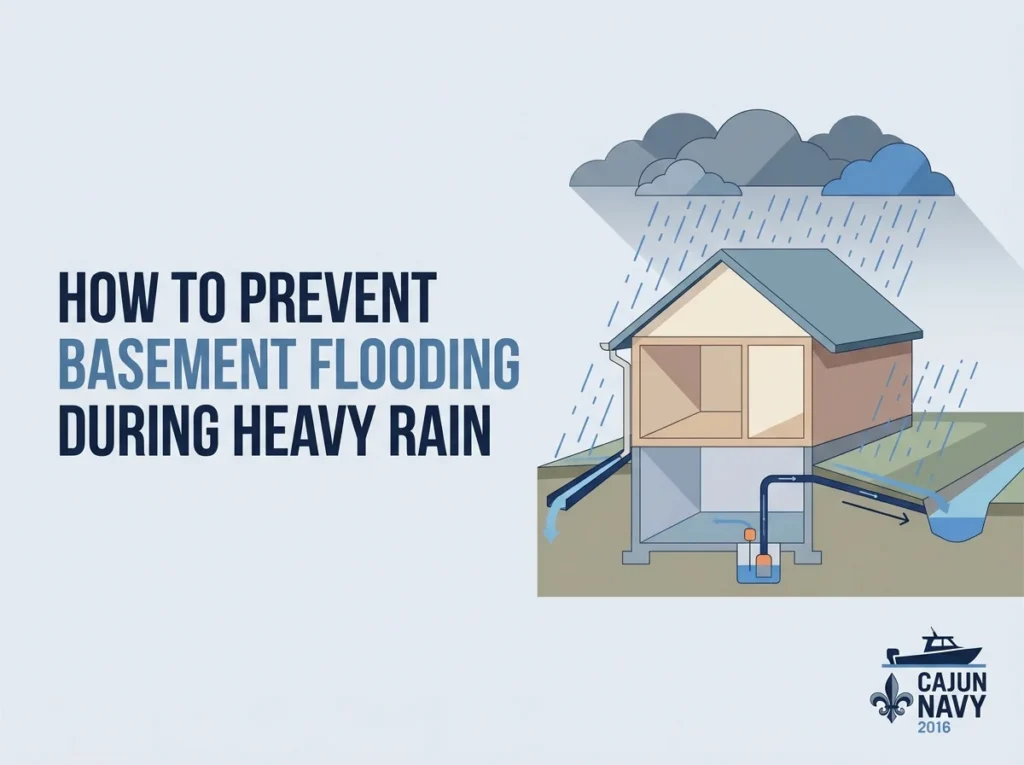

To prevent basement flooding during heavy rain, you need to do two things: keep rainwater away from your foundation on the outside, and give any water that does get in a way to leave on the inside. The most effective steps are extending your downspouts at least 6 to 10 feet from the house, cleaning your gutters, grading the soil so it slopes away from your foundation, sealing cracks in basement walls and floors, and installing a sump pump with a battery backup. Add a backwater valve to stop sewer backups and a few water sensors for early warning, and you’ve covered the vast majority of flooding causes. As a volunteer flood-response organization, Cajun Navy 2016 has seen thousands of flooded homes across the country, and we can tell you that most basement flooding is preventable, but we can also tell you the one thing that matters most and is easy to overlook: knowing when a wet basement stops being a maintenance problem and becomes an emergency.
Here’s the complete guide, including the safety part that matters most.
Why Basements Flood During Heavy Rain
Understanding why it happens makes every fix make sense, so stick with us for a minute.
When rain falls faster than the ground can soak it up, water piles up in the soil around your home. And your basement? It’s the lowest point water can reach. Water always goes to the lowest point, every time. So it pushes against your foundation walls and floor, hunting for any crack, gap, or weak spot to sneak through. There’s a name for that pressure. It’s called hydrostatic pressure, and in a bad storm it gets strong enough to force water through hairline cracks you never even knew were there.
Water finds its way in a few main ways. Through cracks in the walls or floor. Backing up through floor drains when the city sewer gets overwhelmed. Overflowing from clogged gutters and pooling against the foundation. Pouring in through window wells that fill up like little swimming pools. Or rising straight up through the ground when the water table climbs too high.
Every fix below is built to shut down one or more of those paths. So let’s close them off.
Start Outside: Keep Water Away From Your Foundation
The best flooding fix is the one that stops water before it ever touches your walls. So most of your effort belongs out here, on the outside of the house.
Extend your downspouts. If you do one thing on this whole list, do this. It’s the cheapest fix and it stops the most common cause. Downspouts that dump rainwater right next to your foundation are basically pouring water exactly where you don’t want it. Add extensions so the water comes out at least 6 to 10 feet from the house. Splash blocks help a little. Proper extension pipes help a lot more.
Clean your gutters. Clogged gutters overflow, and that overflow runs right down your walls and pools at the base of your foundation. Clean them twice a year at minimum, more if you’ve got trees dropping leaves everywhere. Gutter guards cut down how often you’re up on that ladder. Boring job, big payoff.
Fix your grading. The ground around your house should slope away from the foundation, not toward it. Problem is, soil settles over the years and quietly creates low spots that funnel water back against your walls. Here’s a trick: walk around your house during a rainstorm and just watch where the water goes. If it pools against the foundation or runs toward the house, add soil (clay-rich soil works best) to build the grade back up. You’re aiming for about 6 inches of drop over the first 10 feet.
Cover your window wells. Got basement windows below ground level? Those window wells can fill up during heavy rain and shove water right through the window frame. Keep them clear of leaves and debris, make sure they actually drain, and put fitted covers on them to keep the rain out.
Check where your yard drains. If your property naturally sends water toward your house, you might need a French drain or a swale to reroute it. Bigger project, yes. But for homes sitting in a genuinely wet spot, it can be the whole difference between a dry basement and a problem that comes back every single storm.
Then Inside: Give Water a Way Out
Even with great defense outside, some water can still sneak in during an extreme storm. That’s where your interior systems come in. Your backup plan.
Install and maintain a sump pump. A sump pump sits in a pit at the lowest point of your basement. When water collects there, the pump kicks on and pushes it out and away from your house. Live anywhere with real flooding risk? A sump pump isn’t optional. Test it a few times a year by pouring water into the pit and making sure it turns on and drains like it should.
Add a battery backup to that sump pump. This one’s critical, and it’s the one everybody skips. Think about it. Heavy storms knock out the power. And the second the power dies, a normal sump pump quits working, at the exact moment you need it running. A battery backup keeps it going through the outage. We can’t stress this enough. The number of flooded basements we’ve walked into where the homeowner had a perfectly good sump pump that died the instant the power went out, it’s heartbreaking, because it never had to happen.
Install a backwater valve. During heavy rain, city sewer systems get overwhelmed and back up into homes through the floor drains. Nasty problem. A backwater valve is a one-way gate on your sewer line. It lets waste flow out but slams shut the moment water tries to come back in. If you’ve ever had a sewer backup, this is one of the best investments you can make.
Seal cracks in walls and floors. Look over your basement walls and floor for cracks and damp spots. Seal the small ones with waterproof hydraulic cement or a masonry sealant. This won’t stop a major flood, but it’ll stop the slow seepage that quietly wrecks a basement over time. Big or structural cracks? Get a professional to look at those.
Put down water sensors. Small wireless water alarms near the sump pit, the water heater, and any low spots will alert you the second water starts rising. Some connect to your phone, so you get the warning even when you’re not home. That early heads-up buys you time to act before a little water becomes a big disaster.
The Prevention Priorities That Actually Matter Most
Here’s something worth knowing, because it’s tempting to treat every fix as equally important. It isn’t.
Short on time and money? Do them in this order. First, extend your downspouts, because it’s cheap and it stops the most common cause. Second, get a sump pump with a battery backup, because it’s your safety net when everything else fails. Third, fix your grading, because it goes after the root cause of foundation water. Fourth, add a backwater valve if you’ve ever had any kind of sewer backup. Everything else comes after those four.
Why this order? Because we’ve seen which failures actually flood homes. And it’s almost always the same three culprits. The downspout dumping right at the foundation. The sump pump that died when the power cut out. The graded soil that funneled water straight back against the walls. Fix those first, and you’ve handled most of your risk.
When a Wet Basement Becomes an Emergency
This is the part no restoration company or insurance page will tell you, and it’s the most important section in this whole guide. There’s a difference between a basement taking on a little water and a situation that’s genuinely dangerous. You need to know where that line is.
A little water seeping in during a storm? That’s a maintenance problem. You can manage it, mop it up, and prevent it next time. But when water is rising fast, when it’s coming in quicker than you can bail it, or when it’s creeping up toward electrical outlets, your furnace, or your water heater, you’re not dealing with maintenance anymore. You’re dealing with an emergency. And right then, your priority flips from saving the basement to keeping yourself safe.
Fast-rising basement water is exactly the kind of thing our volunteers respond to during major storms. And the people who get hurt? Almost always the ones who stayed too long, trying to save belongings or bail water that was never going to stop. Property can be replaced. You can’t.
The Electrical Danger Nobody Warns You About
Here’s a warning that could save your life. A flooding basement is full of electrical hazards. Outlets, the furnace, the water heater, the breaker panel, and any appliances or extension cords are all potential sources of electrocution once water rises to reach them.
Never walk into standing water in a basement if that water could be in contact with electrical outlets, wiring, or appliances. Water conducts electricity, and a flooded basement with live electrical current can kill you the moment you step in. If water has risen to the level of any electrical fixtures, and you cannot safely shut off the power to the basement from a dry location, stay out and call for help.
This is the single most dangerous mistake we see people make during floods. They rush down to save something, step into charged water, and the outcome is tragic. No possession in that basement is worth your life.
When to Stop and Get Out
We’re a flood-response organization, so we’re going to be honest with you in a way a company selling basement cleanup never will. Sometimes the right move is to stop fighting and leave.
If water is rising faster than you can manage, if it’s reached electrical systems, if the storm outside is still intensifying, or if local authorities have issued evacuation orders, stop what you’re doing and get to safety. Get everyone in your household to higher ground. Don’t drive through flooded roads. Don’t go back for belongings. Just get out and stay out until it’s safe.
Every flood season, lives are lost by people who underestimated how fast water rises and how quickly a manageable situation turns deadly. Prevention is about protecting your property. But when prevention is overwhelmed, protecting your life is the only thing that matters.
What to Do After the Water Recedes
Once it’s safe and the water is gone, act quickly to limit damage. Document everything with photos before you clean up, for insurance. Remove standing water and wet materials fast, because mold can start growing within 24 to 48 hours. Run fans and dehumidifiers to dry the space thoroughly. And figure out how the water got in so you can prevent it next time, because a basement that floods once will flood again if the cause isn’t fixed.
A Note for Flood-Prone Regions
If you live in a part of the country where flooding is common, prevention isn’t optional, it’s essential. States along the Gulf Coast like Texas, Louisiana, Florida, and Mississippi, along with flood-prone areas throughout the Midwest along the Mississippi and Ohio rivers, face flooding risks far beyond the average heavy rainstorm.
In flood-prone regions like Louisiana, where our volunteers provide flood response during water emergencies, we’ve watched how fast a few inches of basement water can turn into a genuine crisis when a storm stalls overhead or a river crests. If you’re in a high-risk area, take prevention seriously, know your evacuation routes, keep an emergency kit ready, and never assume a storm will behave the way the last one did. The homes that come through flooding best are the ones where the family prepared before the water started rising, not after.
Bottom Line
Preventing basement flooding during heavy rain comes down to keeping water away from your foundation on the outside and giving it a way out on the inside. Extend your downspouts, clean your gutters, fix your grading, seal your cracks, and run a sump pump with a battery backup. Add a backwater valve and water sensors for good measure. Do the high-priority items first.
But remember the part that matters most. A wet basement is a maintenance problem right up until it isn’t. When water rises fast, reaches electrical systems, or a storm turns dangerous, your job is no longer to save the basement. It’s to save yourself and your family. Prevention protects your home. Knowing when to walk away protects your life.
Frequently Asked Questions
What is the cheapest way to prevent basement flooding?
Extending your downspouts is by far the cheapest and most effective single step. For the cost of a few extension pipes, you route rainwater 6 to 10 feet away from your foundation, which stops one of the most common causes of basement flooding. Cleaning your gutters regularly costs nothing and is nearly as important.
Do I really need a battery backup for my sump pump?
Yes, if flooding is a real risk where you live. Heavy storms are exactly when power outages happen, and a standard sump pump stops working the moment the power goes out. A battery backup keeps it running through an outage, which is often the exact moment you need it most. A sump pump without a backup can fail at the worst possible time.
Is it safe to go into a flooded basement?
Not if the water has reached electrical outlets, appliances, wiring, or your electrical panel. Water conducts electricity, and a flooded basement with live current can be fatal. If you cannot safely shut off power to the basement from a dry location, stay out and call for help. No belongings are worth the risk of electrocution.
How much does it cost to waterproof a basement?
It varies widely depending on what you need. Simple fixes like downspout extensions and crack sealing cost very little. A sump pump with battery backup runs a few hundred dollars. A backwater valve is a moderate plumbing cost. Full professional waterproofing with exterior excavation and drainage can run into the thousands. Start with the cheap, high-impact fixes first.
How do I know if my home is at high risk for basement flooding?
Check whether your home sits in a low spot, whether the ground slopes toward your foundation, whether you’re in a FEMA flood zone, and whether you’ve had water in the basement before. Homes in flood-prone regions, near rivers, or in areas with a high water table are at greater risk. If you’ve flooded once, you will flood again unless the cause is fixed.
When should I evacuate instead of trying to protect my basement?
Stop protecting the basement and get to safety when water is rising faster than you can manage, when it has reached electrical systems, when the storm is still intensifying, or when local authorities issue evacuation orders. Your life matters more than your property. Get everyone to higher ground, avoid flooded roads, and don’t return until it’s safe.