
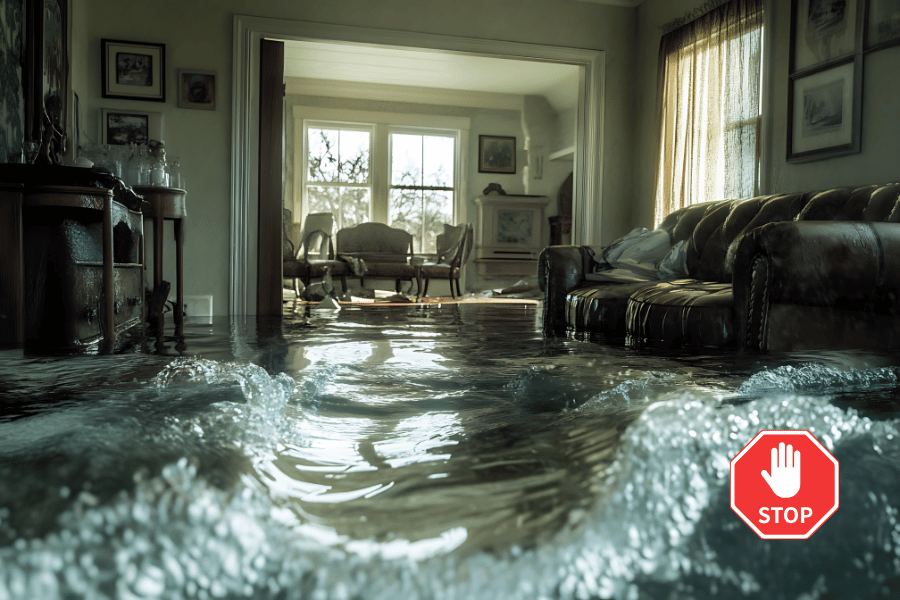

To stop flood water from entering your house, start by directing rainwater away from your foundation with clean gutters and properly graded soil, seal every crack in your basement walls and foundation with waterproof sealant, and have a working sump pump with battery backup ready to go. If water is rising right now, stack sandbags or deploy flood barriers at every door and ground-level opening, shut off your main circuit breaker if water is near outlets, and move to higher ground inside your home immediately.
Those are the basics. But after responding to floods across the country, from the 2016 Louisiana Great Flood to Hurricane Helene in North Carolina, Cajun Navy 2016 volunteers have seen first-hand what separates homes that survive flooding from homes that don’t. The difference almost always comes down to preparation done before the storm, not heroics during it. This guide covers everything: what to do right now if water is already threatening your home, and how to build the layered defenses that keep floodwater out in the first place.
Why Flood Water Is So Dangerous
Before getting into prevention, it helps to understand what you are actually keeping out. Floodwater is not clean water. The CDC warns that floodwater typically contains sewage, chemicals, debris, and disease-carrying organisms. NOAA adds that floodwater often carries oil, sharp objects, and displaced animals.
The physical force is just as dangerous. According to the National Weather Service, just 6 inches of fast-moving water can knock an adult off their feet. Twelve inches can sweep away a car. Eighteen to 24 inches will carry away SUVs and trucks.
And the financial damage is staggering. FEMA reported $8.8 billion in flood damage to homes and businesses in 2024 alone. Nearly $3.9 billion of that, roughly 44%, happened in communities not even designated as high-risk flood zones. Flooding does not only happen on the coast or after hurricanes. It happens in neighborhoods that never expected it.
Emergency Steps: Flood Water Is Rising Right Now
If you are reading this because water is already approaching your home, here is what to do immediately. (For open-water flooding and rising rivers, see our flash flood survival guide for additional safety steps.)
Build Sandbag Barriers at Entry Points
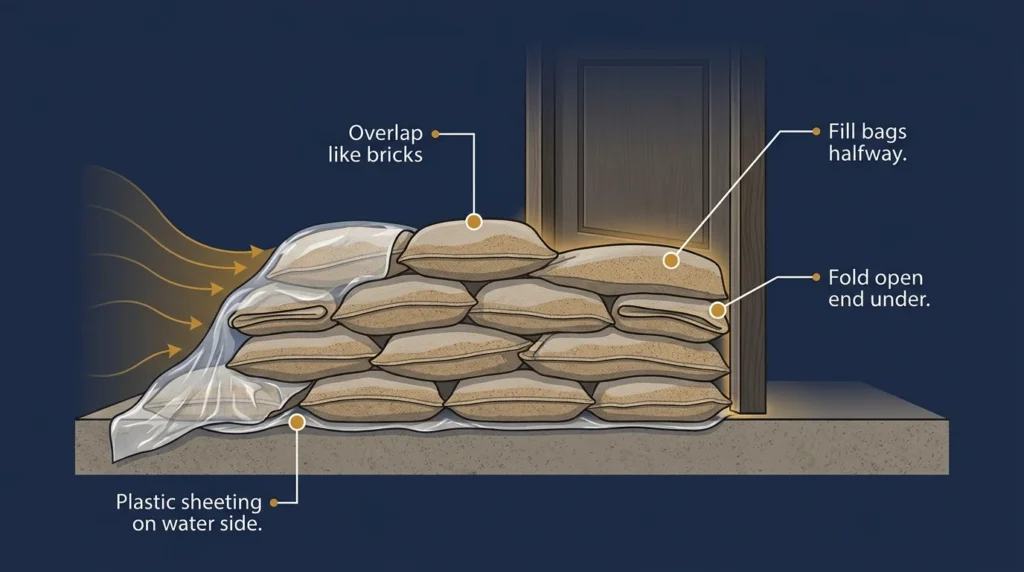
Stack sandbags at every door, garage opening, and ground-level vent. Fill each bag about halfway with sand, fold the open end under, and lay them like bricks with the folded side facing the water flow. Build walls at least two layers wide and two layers high. Lay plastic sheeting (at least six mils thick) on the water side first, then stack the bags on top to hold it in place. Overlap the sheeting by at least three feet at each seam.
Stomp each bag down firmly after placing it. Gaps between bags are where water gets through. The goal is a continuous, compressed barrier with no daylight between bags.
Deploy Modern Flood Barriers
If you do not have sandbags, self-inflating flood barriers are a faster alternative. Products like Quick Dam and similar water-activated barriers expand when saturated, typically within 5 to 10 minutes. Place them across doorways and garage openings. Unlike sandbags, these can be dried, stored, and reused for 6 to 12 months.
Shut Off Utilities Safely
If water is approaching electrical outlets or your breaker panel, turn off the main circuit breaker immediately, but only if you can reach it safely without standing in water. The CDC is clear on this: never turn power on or off while standing in water. If you cannot reach the panel safely, leave it and get to higher ground. Also shut off gas valves if you are evacuating.
Move to Higher Ground Inside Your Home
Get to the highest floor of your house. Avoid basements entirely. If you have time, carry electronics, important documents, and medications upstairs. Store irreplaceable items in waterproof bins if you have them. But do not waste time on belongings if water is rising fast. Cajun Navy 2016 volunteers have seen too many people stay too long trying to save possessions. Your safety comes first.
Exterior Drainage: Keep Water Moving Away from Your Foundation
The most effective flood prevention starts outside your house. Water follows gravity, and your job is to make sure gravity pulls it away from your foundation, not toward it.
Clean Gutters and Extend Downspouts
Clogged gutters overflow and dump water directly against your foundation walls. Clean them at least twice a year, more if you have overhanging trees. Then check your downspouts: they should discharge water at least 6 to 10 feet from the foundation. Attach extensions or splash blocks to carry runoff well clear of the house. If your downspouts currently dump water right next to the wall, this single fix can make a significant difference.
Also clear any yard drains and basement floor drains. A backed-up drain during heavy rain turns your drainage system into a funnel pointed at your house.
Grade Your Yard Away from the House
The soil around your foundation should slope downward and away from the house. The standard recommendation is about 6 inches of drop over the first 10 feet from the foundation wall. If water pools against your foundation during rain, the grade is wrong.
You can fix minor grading issues yourself with topsoil and a rake. Pack the soil firmly. For serious drainage problems, especially if your yard slopes toward the house, consider a French drain or swale system. A French drain is essentially a gravel-filled trench with a perforated pipe that collects water and redirects it away from the foundation.
Protect Window Wells and Basement Openings
Basement windows below ground level are a common entry point for floodwater. Make sure window wells have functioning drains at the bottom, and keep those drains clear of leaves and debris. Install fitted window well covers made of polycarbonate or metal to keep debris out and stop water from pooling inside the well during heavy downpours.
Check every ground-level opening: dryer vents, crawl space access points, and utility line penetrations through your foundation wall. Seal gaps around pipes and cables with hydraulic cement or exterior-grade caulk.
Seal Your Foundation and Walls
Even with good drainage, water can seep through cracks and pores in concrete. Sealing your foundation creates a second line of defense.
Fix Cracks with Hydraulic Cement or Epoxy
Inspect your basement walls and floor at least once a year. Look for cracks, especially where walls meet the floor, around window frames, and near any pipe penetrations. Seal hairline cracks with waterproof epoxy injection. For larger cracks, use hydraulic cement, which expands as it cures and forms a watertight bond even in wet conditions.
Do not ignore small cracks. Water pressure during a flood can force water through openings you would not notice on a dry day.
Apply Waterproof Coatings to Exterior Walls
Coat your exterior foundation walls, up to about 3 feet above the soil line, with a waterproof membrane or sealant. This creates an exterior barrier that stops slow seepage through porous concrete. Several products are available for DIY application, from brush-on coatings to peel-and-stick membranes.
For chronic water intrusion, an interior waterproofing system (drain tile along the footing connected to a sump pit) can intercept water before it reaches your living space. This is a bigger investment, but it addresses the problem at its source.
Install Flood Vents in Crawl Spaces
If you live in a flood-prone zone, flood vents (also called foundation vents) allow water to flow through your crawl space or enclosed foundation rather than building up pressure against the walls. Without vents, hydrostatic pressure from rising water can crack or collapse foundation walls. Check FEMA guidelines for requirements in your area, as these are often required by building codes in designated flood zones.
Interior Pumps and Protections
Even the best exterior defenses can be overwhelmed. Interior systems are your last line.
Sump Pump with Battery Backup
A sump pump installed at the lowest point of your basement is essential for any home with water intrusion risk. The pump sits in a sump pit and automatically activates when water reaches a certain level, pumping it out and away from your foundation.
Here is the critical part most people miss: your sump pump needs a battery backup. Cajun Navy 2016 has seen thousands of flooded homes across the country, and one of the most common failures is a sump pump that died when the power went out. Storms cause power outages. Power outages kill sump pumps. Battery backups and water-powered backup pumps solve this. Test your sump pump quarterly by pouring water into the pit and confirming it activates and drains properly.
Install a wireless water alarm near the sump pit. A simple battery-powered sensor that alerts you the moment water rises will give you time to act before a small problem becomes a flooded basement.
Backflow Valves on Sewer Lines
During heavy flooding, municipal storm drains and sewer systems can back up, pushing sewage and stormwater into your basement through floor drains and toilets. A backwater valve (also called a backflow valve) installed on your main sewer line prevents this. The valve allows wastewater to flow out but closes automatically if water tries to flow back in.
Have a licensed plumber install this. It is one of the most effective single investments for flood-prone homes, and some municipalities offer rebates or require them in flood zones.
Elevate Appliances and Utilities
Raise your furnace, water heater, electrical panel, washer, and dryer above potential flood levels. Even elevating them a few inches on concrete blocks can protect them from a shallow flood. The National Flood Insurance Program recommends elevating machinery and appliances above the first floor level where possible.
If full elevation is not practical, at minimum move the electrical panel and HVAC system off the basement floor. The repair or replacement cost for a flooded furnace or electrical panel runs into thousands of dollars, while the cost of raising them on a platform is minimal.
After the Flood: Re-Entering Your Home Safely
Once floodwater recedes, do not rush back inside. The CDC recommends waiting until local authorities confirm it is safe and following these precautions:
Open doors and windows for at least 30 minutes before spending time inside. Do not turn on the HVAC system until a certified technician inspects it, as running a contaminated system spreads mold throughout the house. Never run a generator, pressure washer, or any gasoline-powered equipment indoors or within 20 feet of any window, door, or vent. Carbon monoxide from generators is one of the leading causes of post-flood deaths.
Mold can begin growing within 24 to 48 hours after flooding. Remove wet materials, dry out the space as quickly as possible using fans and dehumidifiers, and clean hard surfaces with a detergent solution. If flooding was extensive, a professional mold remediation company may be necessary.
As Cajun Navy 2016 founder Jon Bridgers Sr. has noted about their Washington State deployment: “After the waters recede, that is when the real work begins. Families are left with homes filled with mud and debris, roads blocked, and no clear path forward.” Having a recovery plan matters as much as having a prevention plan. If your home has suffered major flood damage and you need help, learn how Cajun Navy 2016 supports flood-affected communities or join the team to help others recover.
Flood Insurance: What Every Homeowner Needs to Know
Standard homeowner’s insurance policies do not cover flood damage. This catches many homeowners off guard after a flood. Flood insurance through the National Flood Insurance Program (NFIP) or a private provider is the only way to protect your finances against flood damage to your home and belongings.
Even if you do not live in a designated high-risk flood zone, consider coverage. FEMA’s own data shows that 44% of flood damage in 2024 occurred in communities not classified as high risk. Flooding can happen anywhere it rains heavily, anywhere drainage fails, and anywhere infrastructure is aging. Cajun Navy 2016 has deployed to states from Louisiana to Washington for exactly this reason. Flood insurance policies typically take 30 days to go into effect, so purchasing one after a storm is in the forecast is too late.
Check your flood risk using the FEMA Flood Map Service Center to see if your property falls in a designated flood zone.
Frequently Asked Questions
Do sandbags really stop flood water?
Yes, properly stacked sandbags can block or significantly reduce water entry through doorways and low openings. The key is technique: fill bags halfway, fold the open end under, stack them like bricks in overlapping rows, and stomp each one flat to eliminate gaps. Adding plastic sheeting on the water-facing side improves the seal. Sandbags work best against slow-rising water up to about two feet deep. For deeper or fast-moving water, they may slow the flow but cannot fully stop it.
How high should I raise my appliances above potential flood level?
At minimum, raise furnaces, water heaters, washers, dryers, and electrical panels at least 12 inches above the highest known flood level for your area. If you live in a FEMA-designated flood zone, elevate above the Base Flood Elevation (BFE) listed for your property. Even a few inches of elevation on concrete blocks can prevent thousands of dollars in damage from a shallow flood.
Does homeowner’s insurance cover flooding?
No. Standard homeowner’s insurance policies specifically exclude flood damage. You need a separate flood insurance policy, either through the National Flood Insurance Program (NFIP) or a private insurer. Policies typically take 30 days to become effective, so you cannot buy one after a storm is already in the forecast.
What is the cheapest way to flood-proof a house?
The most cost-effective measures are the ones you can do yourself: clean your gutters, extend downspouts 6 to 10 feet from the foundation, fix your yard grading so water slopes away from the house, and seal foundation cracks with hydraulic cement. These basic steps cost under a few hundred dollars and prevent the most common causes of water entry. A battery backup for your sump pump is another high-value, relatively low-cost investment.
Should I use sandbags or modern flood barriers?
It depends on your situation. Sandbags are cheap and widely available, but they are heavy, messy, and single-use. Self-inflating flood barriers activate in 5 to 10 minutes when exposed to water, are lighter to store, and can be reused for 6 to 12 months. For homeowners in flood-prone areas, having reusable barriers stored in the garage means faster deployment when warnings come. For a one-time emergency, sandbags from your local fire station or municipality will work.
How long before a flood should I start preparing my home?
Long-term preparations (grading, sump pumps, drainage, foundation sealing) should happen before flood season, not when a storm is in the forecast. For emergency preparations like deploying barriers and moving valuables upstairs, act as soon as a flood watch or warning is issued for your area. During Cajun Navy 2016’s Hurricane Ida response, the team staged equipment before the storm made landfall because waiting until the last minute eliminates your options. The same applies to your home: prepare early, and you have choices. Wait, and you have none.