

A long-track tornado is simply a tornado that stays on the ground and travels a very long distance. In practice, meteorologists often call a twister “long-track” if it remains in contact with the ground for tens of miles – typically on the order of 25–30 miles or more. In other words, instead of touching down briefly for a few minutes, a long-track tornado can last for an hour or longer, carving a long swath of damage across the landscape. These storms are powered by intense, long-lived supercell thunderstorms. Because they can survive and grow for so long, long-track tornadoes are usually much stronger than average tornadoes (often rating EF2 or higher) and can cause catastrophic destruction.
Meteorologists note there is no single hard cutoff for “long-track,” but think roughly 15–20 miles or more on the ground. For comparison, most tornadoes last under 10 minutes with an average path of only about 3½ miles. By contrast, a long-track storm may be on the ground for several miles and several minutes at a time, moving straight through entire towns or across state lines. It takes a very potent supercell and highly favorable atmospheric conditions (strong wind shear, extreme instability, etc.) to keep a tornado going that long. In short, a long-track tornado is an unusually powerful twister that survives far longer than normal.
Key Characteristics of Long-Track Tornadoes
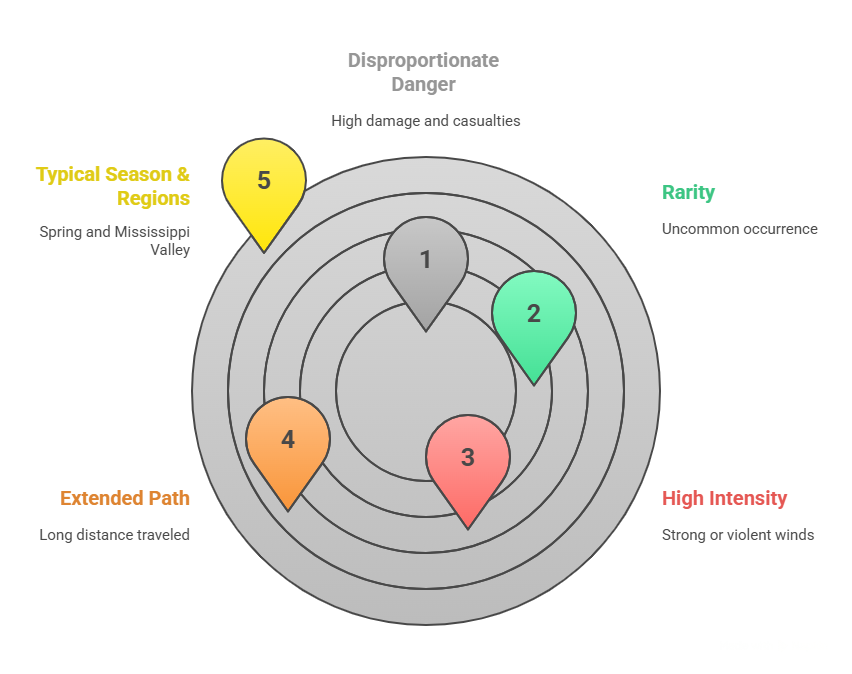
- Extended Path: By definition, these tornadoes travel many miles. Studies often use ~25 miles as a threshold. One NOAA climatology found that requiring at least 25 miles on the ground captured the most long paths.
- High Intensity: Long-track tornadoes tend to be strong or violent. They often reach EF3, EF4 or even EF5 intensity on the Enhanced Fujita scale (EF4 means 166–200+ mph winds). In fact, research shows nearly 80% of twisters with paths ≥25 miles were rated at least F/EF2 (and many were F3 or higher).
- Rarity: These storms are very uncommon. One study of U.S. tornadoes (1979–2018) found that long-track twisters (≥30 miles) made up less than 1% of all tornadoes. In NOAA’s historical records, about 1.2% of tornadoes (F3–F5) had paths of 25+ miles. Yet despite their rarity, these few storms account for a huge share of damage and casualties.
- Disproportionate Danger: Because they are so powerful and last so long, long-track tornadoes cause a disproportionate number of fatalities and injuries. The same NOAA study noted that the roughly 1% of tornadoes with ≥25-mile tracks produced about 46% of the total tornado destruction potential. Another analysis confirms they cause most of the deaths and damage even though they are rare.
- Typical Season & Regions: Long-tracks most often occur in spring, especially April–May, and they tend to happen in the Mississippi Valley / Southern Plains area. Surprisingly, research shows they often strike the Southeast U.S. (especially during outbreaks) nearly as much as Tornado Alley in the Plains. (For example, the catastrophic 2021 Kentucky tornado in December was an unusually late-season long-track event.)
How Do Long-Track Tornadoes Form?
Long-track tornadoes almost always form from supercell thunderstorms – the most intense, rotating thunderstorms. A supercell has a strong updraft and a rotating “mesocyclone” aloft. Under very favorable conditions (strong wind shear through the atmosphere, lots of humid instability, a “cap” that breaks late), a supercell can sustain a tornado for a very long time. As Fox Weather explains, “it takes a potent supercell with extremely favorable conditions for a tornado to survive for an extended period of time”. The tornado’s inflow of warm moist air must remain uninterrupted. If the parent storm slows down or collapses, even a strong tornado will fizzle out. But in extreme cases, nothing stops it – the storm keeps feeding it, and the tornado just keeps going.
Meteorologists have noted that stronger shear and instability help these storms persist. For instance, on May 16–17, 2025 an outbreak of storms across Kentucky produced a deadly long-track tornado. In that case, forecasters observed very high low-level wind shear and heat energy (CAPE), along with a strong jet stream – “conditions [that] were very conducive for strong, long-track tornadoes”. In short, a long-track tornado is born when all the ingredients for tornado formation are met exceptionally well: extreme instability, strong turning winds with height, and a powerful supercell updraft.
Why Long-Track Tornadoes Are So Dangerous
Because they last so long and stay on the ground, long-track tornadoes wreak havoc over a huge area. They can sweep through entire towns or multiple counties. The damage path can be tens of miles long and up to a mile or more wide in places. These storms almost always pack severe wind speeds (EF3–EF5), so they level homes, throw cars, uproot trees, and hurl debris over great distances. Eyewitnesses often describe them as violent, “mile-wide” monsters cutting through communities.
Key facts about their impact:
- Outsize Fatalities: Even though they’re rare, long-track tornadoes cause a large share of deaths. One journal found that tornadoes ≥30 miles (long-track) had a disproportionate number of fatalities and injuries compared to shorter tornadoes. For example, research shows long-track twisters in the Southeast U.S. accounted for many outbreak deaths in recent decades.
- Path and Duration: Many long-track tornadoes stay on the ground for hours. For instance, a 2016 Kansas tornado (EF4) remained on the ground over an hour, carving a 60+ mile path. During that time it was up to half a mile wide and destroyed everything in its path. Longer life means more time to tear things apart.
- Total Damage: Because they travel so far, the total damage is immense. NOAA analysis showed that violent tornadoes (F3–F5) with ≥25 mile tracks produced about 46% of all estimated tornado damage potential in the study period. In other words, a handful of big storms did nearly half the damage.
To summarize, long-track tornadoes stand out because of how powerful and persistent they are. They operate at the top of the EF-scale and move like armored bulldozers through the landscape. The combination of long duration, high wind speeds, and wide path means catastrophic destruction along their route.
Notable Long-Track Tornadoes
Some of the most infamous tornado disasters were long-track events. A few examples:
- 1925 Tri-State Tornado (Missouri/Illinois/Indiana): This is the record-holder. It stayed on the ground for about 219 miles and lasted 3½ hours, leveling towns in three states. It was rated F5 (over 200 mph winds) and killed 695 people – still the deadliest U.S. tornado. (Note: some historical sources debate if it was one continuous tornado or a family, but its continuous damage path set the benchmark.)
- Western Kentucky Tornado, Dec 2021: A modern example, this EF4 tornado from late 2021 carved a path ~166 miles long. It struck multiple communities and killed dozens of people. This outbreak was notable for a rare late-season long-track event in the Ohio Valley.
- Bangladesh (Daulatpur–Saturia, 1989): Outside the U.S., Bangladesh has deadly long-track tornadoes. In 1989 an enormous tornado (estimated 1.5 km wide) cut 80 km (50 miles) across central Bangladesh, causing over 1,300 deaths. This remains the deadliest tornado on record. (The country’s poor construction and lack of warnings made it especially deadly, but its 50-mile path classifies it as a long-track twister.)
- Other Examples: Many violent storms in U.S. history had long tracks: e.g. parts of the May 2011 Super Outbreak, and various Great Plains storms. For example, an EF4 tornado on May 25, 2016 in Kansas had a 60+ mile, 1-hour path. Each of these shows how a single twister, if it stays on the ground, can cause destruction mile after mile.
Staying Safe from Long-Track Tornadoes
Because long-track tornadoes are so dangerous, preparedness is crucial in tornado-prone areas. Even though they are rare, their impact is so great that people in high-risk regions must always take forecasts seriously. Here are some safety tips:
- Know Your Shelter: Have a safe place to go. An underground storm shelter or a small interior room (bathroom, closet) on the lowest floor of a sturdy building can save lives. The more tornado-resistant, the better, especially if an EF3+ tornado is possible.
- Monitor Weather Alerts: When powerful storms approach, NOAA Weather Radios, emergency apps, and media alerts can provide life-saving warning. Pay attention to Tornado Watches (conditions are favorable) and Warnings (a tornado has been spotted or indicated). A “Particularly Dangerous Situation (PDS)” Tornado Watch often signals a risk of violent, possibly long-track twisters.
- Have an Emergency Kit: Keep flashlights, a first-aid kit, water, and radio with fresh batteries in your shelter area. In a long-track event, power and communications may be out, so these basics become vital.
- Plan Ahead: Discuss tornado safety with your family or community. Identify the safest spot in your home or building. Practice drills so everyone knows what to do quickly.
Ultimately, because long-track tornadoes can strike far from where they first touch down, always stay alert during severe weather outbreaks. Meteorologists emphasize that a forecast for possible long-track tornadoes is very serious – if you hear that term in a weather briefing, take immediate cover. With the right preparation and respect for the power of these storms, you can greatly improve your chances if one ever heads your way.