


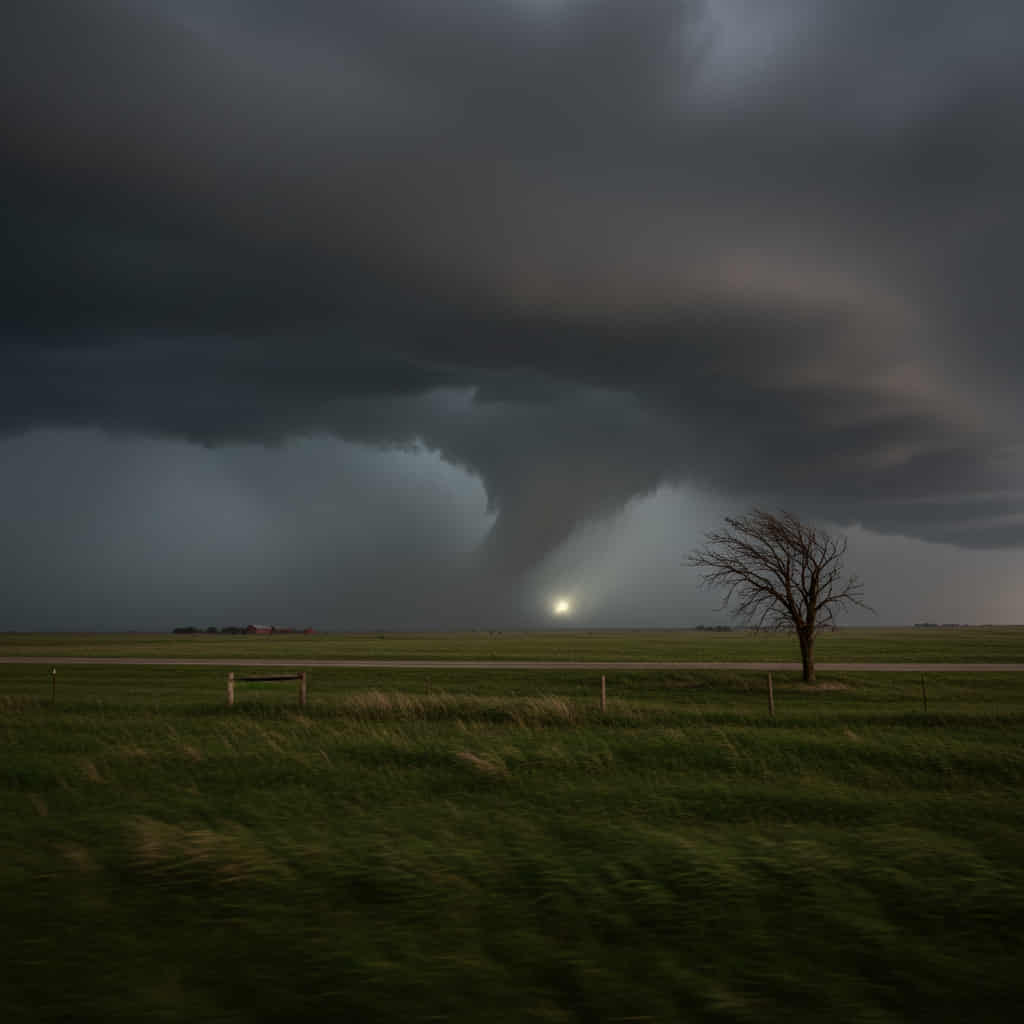
A rain-wrapped tornado is a tornado whose funnel is completely hidden by the heavy rain of its parent thunderstorm. In other words, the powerful vortex is there but you can’t see it – all you see is pouring rain. This happens in very moist, intense storms (often called high-precipitation supercells) when the storm’s rear-flank downdraft (RFD) pulls in rain and wraps it around the tornado. Because the rain acts like a curtain, a rain-wrapped tornado is virtually invisible to anyone on the ground. Meteorologists stress that these are especially dangerous – there may be no visual warning at all of the twister until it strikes.
When this happens, observers see only rain and hear the roar of the storm – they might not notice anything strange until the tornado is upon them. In fact, forecasters say these tornadoes are “obscured by heavy rainfall” and often go undetected without radar or other clues. Only specialized tools can reveal them – for example, Doppler radar may pick up strong rotation or even debris lofted by the wind, and spotters may notice the telltale power flashes from electrical lines arcing in the vortex. In summary: a rain-wrapped tornado = a hidden twister wrapped in rain.
Why Rain-Wrapped Tornadoes Are So Dangerous
- No clear visual funnel: Unlike a classic funnel cloud you can see silhouetted against the sky, a rain-wrapped tornado has no visible funnel. All you see is sheets of pouring rain. Without a funnel or condensation tube, people often don’t realize a tornado is there.
- Hidden by the rain curtain: The intense rainfall of a high-precip storm forms a curtain around the vortex. As one NWS report explains, heavy rain and hail can wrap around the rotating thunderstorm, making the tornado impossible to spot from the ground. People in the storm’s path may only see a gray wall of rain – they often don’t believe it could contain a tornado.
- Only clues are indirect: Since you can’t see the funnel, you must look for other signs. Sometimes a bright power flash (from electrical lines) or an unusual flash of lightning will reveal that a tornado is inside the rain. Other clues include a distinct roar like a freight train, sideways debris whipping through the rain, or sudden violent winds. But by the time these become obvious, the tornado may be very close.
- Common in HP supercells: These hidden tornadoes often occur in high-precipitation (HP) supercell thunderstorms. Meteorologists note that rain-wrapped tornadoes are “especially dangerous” because the same heavy rain that powers the storm also conceals the tornado.
- Radar alerts are crucial: Since sight is unreliable, Doppler radar and spotter reports are the best warning. Forecasters may detect a tight rotation in velocity data or issue a warning based on storm structure even with no visual confirmation. Today’s upgraded radars (dual-polarization) can even identify tornado debris, helping confirm a “rain-wrapped” twister. Without these tools, people under a rain-wrapped tornado often have zero advance warning.
How Rain-Wrapped Tornadoes Form

Rain-wrapped tornadoes form just like other tornadoes, but with a lot more precipitation in the mix. Here’s what happens in a simplified sequence:
- A supercell thunderstorm forms, with a powerful updraft (a column of rising air). Initially the updraft zone is relatively rain-free, and a funnel begins developing.
- As the storm matures, a strong downdraft on the storm’s backside (called the rear-flank downdraft, or RFD) intensifies. This RFD pulls cool, rain-cooled air downward.
- The RFD wraps around the updraft, pulling precipitation (rain and hail) into the circulation around the tornado base. The NSSL explains that the rear-flank downdraft can look like “curtains of rain wrapping around the cloud base circulation.” In other words, rain and hail spiral around the forming tornado.
- As rain encircles the tornado, it completely shrouds the funnel. From the ground, you now see only dense precipitation swirling – the funnel is hidden behind it.
- The tornado may continue intensifying while rain-wrapped. As long as the heavy rain stays wrapped, the tornado remains invisible.
Put simply, a rain-wrapped tornado is still an extremely powerful funnel at the core of the storm’s updraft, but it’s cloaked in the storm’s rains. This is a common behavior in HP supercells. (It also happens in some squall lines and bow echoes, but HP supercells are the classic culprit.)
Detecting a Rain-Wrapped Tornado
Because you can’t rely on sight, radar and other clues become vital:
- Doppler radar velocity: Forecasters watch for tight red-green velocity couplets (adjacent areas of winds moving toward and away from the radar). A strong couplet indicates intense rotation, even if heavy rain masks the funnel on a regular radar image. For example, during the 2015 Charleston tornado, meteorologists saw a distinct velocity couplet and issued a warning even though the tornado was rain-wrapped and at night.
- Dual-polarization (dual-pol) radar: Modern radars send both horizontal and vertical pulses. This lets them identify the type of object in the air. Tornado debris (broken tree limbs, rooftop shingles, etc.) shows up as a very low “correlation coefficient” on dual-pol radar. Research from NOAA’s NSSL found that these debris signatures can confirm a rain-wrapped tornado on the ground. In fact, after dual-pol upgrades, radars are said to “see the unseen” – they can spot debris within 60–75 miles and warn meteorologists that a tornado (even hidden) is causing damage.
- Power flashes and lightning: Sometimes all it takes is a split-second flash to give away the beast. When a tornado rips through a power line or electrical grid, it can cause a bright flash that pierces the rain curtain. In the Tipton (1977) photo above, you can see just such a flash at ground level. Spotters also note that increased lightning or a glowing funnel (when city lights reflect on it) can hint that a hidden tornado is near.
- Auditory and ground clues: Even heavy rain can’t fully mask the sound of a tornado. People often describe a tornado’s sound as a loud, continuous roar (similar to a freight train or waterfall). If you hear that roar coming from the rain, take it as a warning. At ground level, look for flying debris or swirling dust at the edge of the rain. Be wary of any funnel-shaped shaft of rain underneath the cloud base – sometimes only the lower part of the funnel condenses, and you might see a ragged “rag cloud” or debris cloud before the full funnel appears.
In practice, the best advice is not to try to spot it with your eyes. If radar or authorities issue a tornado warning for your area, assume a tornado is on the ground even if all you see is rain. Modern radars and storm spotters give us a heads-up; trust those warnings and seek shelter immediately if one is issued.
Notable Rain-Wrapped Tornadoes
Rain-wrapped tornadoes have occurred in many infamous storms. Here are a few examples:
- Joplin, Missouri (May 2011): The EF5 tornado that devastated Joplin was “heavily rain-wrapped” as it tore through town. Eyewitnesses said the storm’s torrential rain hid the cone in a gray wall, so people often didn’t realize the tornado was there until collapse.
- El Reno, Oklahoma (May 2013): This was the widest tornado ever recorded. It was a massive rain-wrapped, multiple-vortex tornado – so rain completely enclosed its swirls for much of its life. In fact, the Wikipedia article notes it as “this rain-wrapped, multiple-vortex tornado” that ravaged the plains.
- Tri-State Tornado (March 1925): America’s deadliest tornado (695 lives lost) started as a classic supercell, but by the time it hit southern Illinois, it had become a high-precipitation supercell. Heavy rain and hail “nearly [wrapped] around the tornado, largely obscuring it from view”. Researchers studying the event noted that this HP phase made the tornado even more deadly.
- Nebraska (June 2024): In a recent storm, a tornado in Brown County was documented by chasers “before becoming rain wrapped.” The storm reports describe how the vortex was visible briefly, then vanished into the rain. The photo above (from June 20, 2024) captures the moment just before it was fully obscured.
Each of these examples shows the same pattern: the tornado is there, but you only see gray rain. Only after the fact (or with radar confirmation) can we be sure a tornado was occurring.
Staying Safe Under a Rain-Wrapped Tornado
Because rain-wrapped tornadoes offer no visual warning, always rely on official alerts and storm preparedness:
- Monitor weather updates constantly. Have multiple ways to receive warnings – NOAA Weather Radio, smartphone alerts, local news, weather apps. Remember that once a tornado is rain-wrapped, you might not see it, so your devices are key.
- Take warnings seriously. If a Tornado Warning is issued for your area, act immediately. Don’t wait to see the funnel or debris. Go to your pre-determined safe shelter (basement, storm cellar, or interior windowless room).
- Choose a safe location. In a home, go to a basement or small interior room on the lowest level (bathroom, closet). Mobile homes are especially unsafe in tornadoes – plan ahead to shelter elsewhere.
- Watch the wind. Even heavy rain in a calm sky can suddenly be a tornado threat. If you hear a roaring sound or experience sudden straight-line winds or hail, be alert to the possibility that a tornado is nearby, even if you see no funnel.
- Never try to outrun it. If you’re driving and can’t safely reach shelter, abandon the vehicle and lie low in a ditch or culvert (though the best option is always pre-planning to avoid being caught in a car during severe storms).
In short, don’t rely on sight – rely on the warning systems. Rain-wrapped tornadoes hide in plain sight, but forecasters and dual-pol radar technologies are much better at spotting them today. Stay informed, have a plan, and always seek shelter early.
A rain-wrapped tornado is a tornado hidden by its storm’s heavy rain, making it almost invisible. These are among the most dangerous tornadoes because they come without warning. Remember the examples above: in a rain-wrapped tornado, what you hear (or see on radar) is far more important than what you see in the sky.