
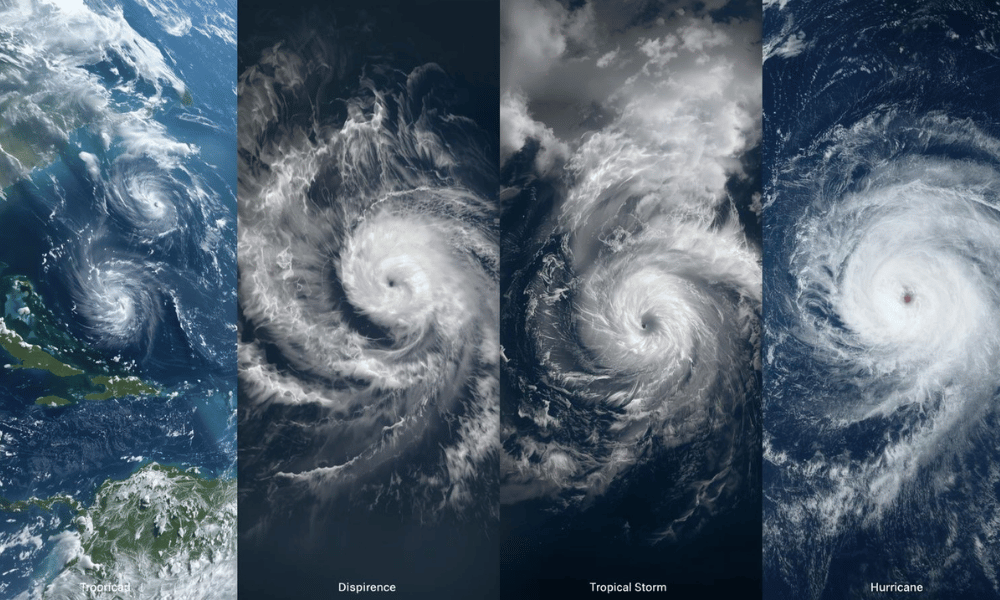

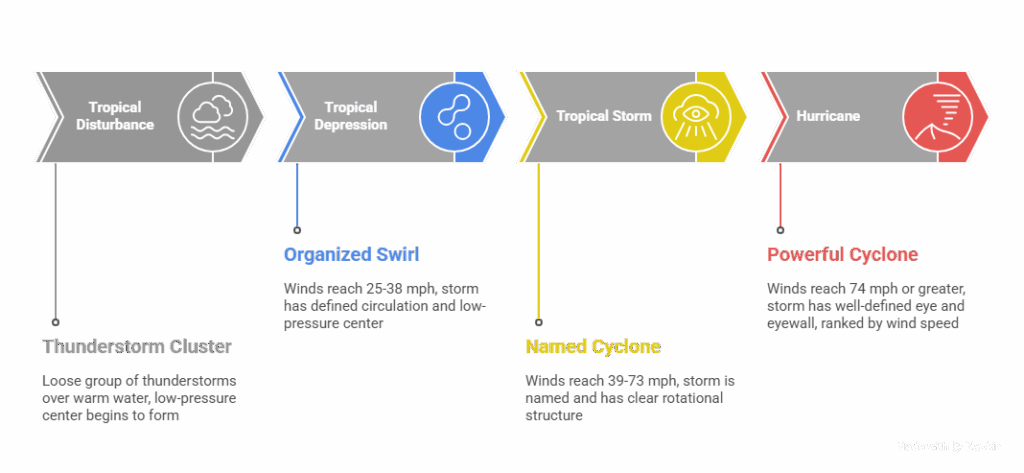
A hurricane develops in four main stages: Tropical Disturbance, Tropical Depression, Tropical Storm, and Hurricane. In other words, it starts as a cluster of warm-cloud thunderstorms over the ocean (a disturbance), then organizes into a depression, strengthens into a named storm, and finally reaches hurricane strength. These storms need very warm ocean water (about 80°F or warmer) as “fuel”. Meteorologists compare a tropical cyclone (hurricane) to a huge heat engine that only runs over hot tropical seas.
- Warm Oceans & Winds Fuel Formation: Hurricanes form over warm tropical oceans where water is at least ~80°F (26.5°C). In these conditions, moist air rises into thunderstorms, releasing heat that warms the storm’s core (much like an engine using fuel). A gentle westward wind (often from Africa) steers the developing storm and keeps the moisture moving. In this tropical setting, a small bump in the atmosphere – called a tropical wave or disturbance – can kickstart the process.
- Stages by Wind Speed: Once this disturbed cluster of thunderstorms persists, it first becomes a tropical depression when winds reach about 25–38 mph. It is upgraded to a tropical storm at 39–73 mph, at which point it is given a name and forms a visible spiral structure. Finally, when sustained winds reach 74 mph or more, the system is called a hurricane. (If the winds climb even higher, the hurricane is categorized by intensity on the Saffir–Simpson scale, as discussed below.)
Tropical Disturbance
The very first stage is a tropical disturbance. Think of it as a loose cluster of thunderstorms over warm water. When hot ocean water evaporates, humid air rises into the clouds and condenses, releasing heat. This heat warms the air above, lowering the pressure at the surface. Surrounding air rushes in and begins to spiral around the low-pressure center (due to the Coriolis effect). NASA explains that as this process continues, “the water vapor from the warm ocean condenses… building the cloud columns higher and larger. A pattern develops with wind circulating around a center… It becomes a cluster of thunderstorm clouds, called a tropical disturbance.”.
A tropical disturbance is the seed of the hurricane. It may last for a day or more; if it holds together, it can intensify. At this point, winds are still relatively light, and damage (if it were to reach land) would be minimal. But the thunderstorms are organized enough to set the stage for further growth.
Tropical Depression
If the disturbance persists and convection continues, winds accelerate and the storm organizes further. When sustained winds in the system reach about 25 to 38 mph (39 km/h), the storm is called a tropical depression. In this stage, the storm has a defined low-pressure center and circulation – basically, all the winds are blowing around a common center. The system looks more like a spinning tropical cyclone, but the core is not yet very strong.
Meteorologists use this threshold to classify it: a tropical depression is still below tropical storm strength, but it has more organized thunderstorms and swirl. (By convention, depressions have one- or two-digit numbers instead of names.) A tropical depression can still cause heavy rain and some gusty winds, but it is not very powerful yet. If conditions are not favorable (e.g. high wind shear or cooler water), the system might weaken or dissipate here. Otherwise, if it keeps strengthening, it will reach the next stage.
Tropical Storm
Once winds pick up to 39–73 mph, the tropical depression becomes a tropical storm. This is when forecasters assign it a name (like “Storm Alpha” or “Tropical Storm Maria”). A tropical storm has a clear rotational structure: bands of rain swirl into the center and the winds spiral faster. NASA notes that at this point “the winds blow faster and begin twisting and turning around the eye, or calm center, of the storm”.
In a tropical storm, an eye may start to form at the center (though it often isn’t well-defined yet). The storm is noticeably stronger – it can still bring flooding rain and coastal surge. For example, even Category 1 hurricanes (≥74 mph) can cause damage. But a tropical storm is still a step below hurricane strength. It serves as the final “ramp-up” stage: if the warm ocean and atmospheric conditions remain favorable, the storm can intensify into a hurricane.
Hurricane
When sustained winds reach 74 mph or greater, the tropical storm is classified as a hurricane. A hurricane is a mature tropical cyclone with a well-defined eye at the center and powerful thunderstorms (the eyewall) around it. NASA describes a typical hurricane as “at least 50,000 feet high and around 125 miles across, with the eye around 5 to 30 miles wide.”. The hurricane’s powerful winds and low central pressure pile up a huge mound of ocean water, which can drive dangerous storm surges onshore. Hurricanes are ranked by wind speed on a 1–5 scale (the Saffir–Simpson scale).
Each step up in category means drastically stronger winds and worse devastation on land. Hurricanes of Category 3 or above are called major hurricanes due to their increased danger
n summary, a hurricane’s lifecycle moves from a loose cluster of thunderstorms (disturbance) to a spinning depression, then to a named tropical storm, and finally to a full hurricane if it strengthens enough. When a hurricane makes landfall or moves over cool water, it loses its warm-water “fuel,” and winds fall off dramatically. Eventually, the storm breaks apart and dies out over land.
Frequently Asked Questions
What triggers a tropical disturbance?
A tropical disturbance often starts from a tropical wave – an elongated area of low pressure moving through the tropics. Warm ocean water evaporating into the atmosphere causes lots of thunderclouds. If enough thunderstorms cluster and rotate together, the disturbance can survive long enough to become a depression.
How fast must winds be to upgrade to each stage?
Winds of 25–38 mph turn a disturbance into a tropical depression. At 39 mph the depression becomes a tropical storm and receives a name. At 74 mph, a tropical storm becomes a hurricane. These thresholds are used worldwide in hurricane advisories.
Why do tropical storms get names?
Once a tropical cyclone reaches storm strength (39+ mph), meteorological agencies name it to help the public track it easily and avoid confusion with other systems. The practice of naming storms dates back decades; it makes communication about storm watches and warnings much clearer.
Do all tropical storms become hurricanes?
No. Many tropical storms never reach 74 mph. If a storm encounters unfavorable conditions (like strong upper-level winds, known as wind shear, or colder water), it can weaken instead of intensifying. In fact, only a fraction of tropical storms strengthen into hurricanes. Others may hover at tropical storm strength or dissipate without ever reaching hurricane strength.