
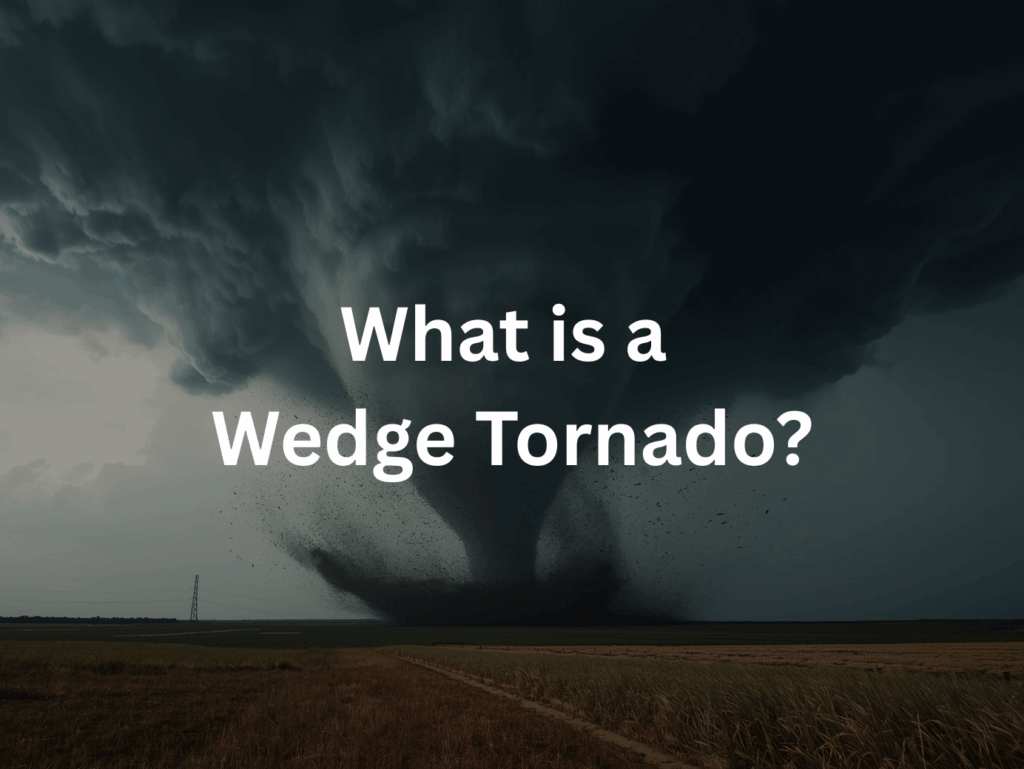

A wedge tornado isn’t a special category in the weather book; it’s just an informal term for a huge, very wide tornado. Imagine a giant funnel cloud so wide at its base that it looks like an upside-down triangle or a blocky wall of cloud touching the ground. In fact, meteorologists say a true wedge tornado has a funnel at least as wide at the ground as it is tall (from the ground up to the cloud base). In plain language: if the tornado’s width is as big as its height, storm spotters will often call it a wedge. These storms tend to stretch a mile or more across, which is why they look so immense on radar and in photos.
Storm chasers and media use the word “wedge” based purely on appearance – it has no formal scientific meaning. So you won’t find a “wedge” box on the storm checklist or damage survey – it just means “this tornado looks really wide!”. Many of the most famous and destructive tornadoes have been wedges (for example, some of them were rated EF-4 or EF-5). However, experts caution that size alone doesn’t guarantee strength. In short, a wedge tornado usually means a very powerful storm, but even a skinny tornado can pack just as much punch.
Key Characteristics of Wedge Tornadoes
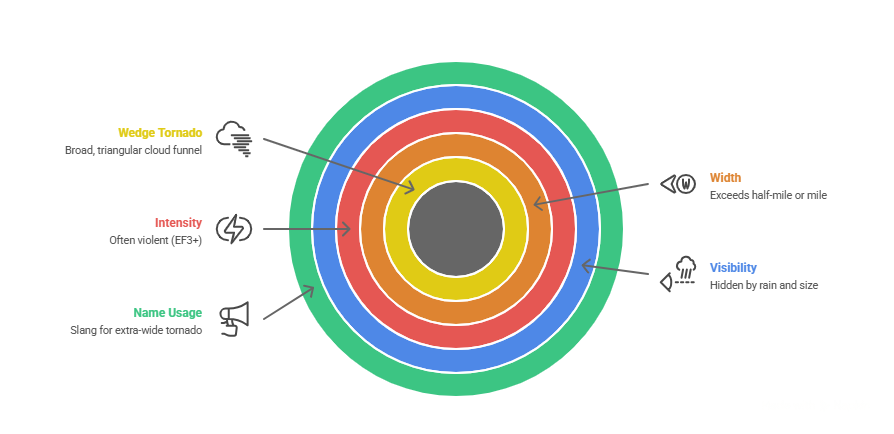
Wedge tornadoes share some distinctive features:
- Shape: They look like a broad inverted triangle or block of cloud reaching down from the storm. By definition, a true wedge has a condensation funnel as wide at the ground as it is tall. Visually, it might appear as a low, wide wall of debris and dust rather than a narrow rope.
- Width: These funnels are huge. Many wedges exceed a half-mile or mile in width, and some go even further. For example, the May 2013 El Reno (Oklahoma) tornado – a classic wedge – ballooned to about 2.6 miles across, setting a U.S. record.
- Intensity: Because wedges are usually products of very strong supercell storms, many of them have been violent. Historically, a lot of wedge tornadoes have been rated EF3 or higher. That said, strength and width are not perfectly linked. Meteorologists note that “a tornado’s size does not necessarily indicate anything about its strength”. In practice this means some wedges have been relatively weak, and some non-wedge tornadoes have reached similar intensities.
- Visibility: A big hazard of wedges is that their size (and heavy rain) can hide them from view. A wedge might look like just a dark, low cloud or a wall of rain from a distance. Observers report that people sometimes mistake a wide wedge for an ordinary rain curtain or shelf cloud until it’s very close. In other words, these funnels can “hide in plain sight,” giving little obvious warning before touchdown.
- Name Usage: Remember, “wedge tornado” is slang, not an official category. Spotters and weather reporters use the word because of the shape, but it doesn’t change how the storm is rated or warned. Basically, it just means “extra-wide tornado”.
Why the Name “Wedge” Tornado?
The nickname comes from the tornado’s visual shape. A wedge is a thick slice of something – think of a cheese wedge or a giant doorstop. When you look up at the storm, a wedge tornado’s funnel is so broad it resembles that chunky, wedge-like form. In fact, the National Weather Service describes it as “wider than the distance from the ground to the ambient cloud base”. This is the opposite of a thin “rope” tornado, which looks like a skinny corkscrew. So basically, meteorologists looked at a very fat, low funnel and thought, “Yep, that looks like a big wedge.”
Wedge Tornadoes: Strength and Myths
Because wedge tornadoes look so ominous, people often assume they must always be the worst storms. And many have been terrible. For instance, the 2011 Joplin, Missouri tornado – an EF5 that devastated a city – was a massive wedge. Fox Weather notes that “some of the most notable and deadly tornadoes in U.S. history have been wedges,” many reaching EF-4 or EF-5 intensity. It’s true that large, wedge-shaped funnels often accompany violent supercells.
However, forecasters warn that you can’t judge a tornado’s strength by its look alone. The NWS specifically says “a tornado’s size does not necessarily indicate anything about its strength”. In practice, this means you might see a skinny rope tornado that actually produces EF3 damage, while a broad wedge might be “only” EF2 (or vice versa). So while wedges often signal big storms, never assume a narrow funnel is safe, and never dismiss a big one. All tornadoes are dangerous, regardless of shape.
Wedge tornadoes also tend to move slowly because of their size, dragging the heavy funnel across the same area for longer. This can extend the damage path. But again, speed and intensity are separate issues. In short, a wedge is scary to see, but whether it’s the deadliest comes down to the storm’s winds and path, not just its width.
Real-Life Wedge Tornadoes
To put it in perspective, here are some real examples of wedge tornadoes:
- The El Reno, Oklahoma (May 2013) tornado was a classic megawedge. As mentioned, it grew to about 2.6 miles wide at one point – wider than the town it passed!
- The Joplin, Missouri (May 2011) tornado was an EF5 wedge that leveled the city. Survey teams and footage show a very wide, ropey funnel, typical of a wedge.
- Many other historic outbreaks included wedges. Video and damage surveys from outbreaks in Kansas, Alabama, and beyond confirm that some of the deadliest twisters – such as the Greensburg, KS (2007) and Moore, OK (2013) storms – had wedge-like funnels.
Each of these real-life storms matches the pattern described above: enormous width, massive debris fields, and often (but not always) extreme intensity. Wherever you see a huge, blocky funnel on the horizon (like in the photo above), you’re looking at what everyone calls a “wedge” tornado.
Stay Safe Around Wedge Tornadoes
In the end, the takeaway is simple: “wedge” just means “really wide.” If you hear that a tornado is a wedge, know it’s a large, dangerous storm – but it should not change what you do. Every tornado, wedge or not, requires the same response. Always treat a tornado warning seriously. Head to a safe shelter (underground or an interior room) as soon as possible, whether the funnel looks skinny or like a huge dark wedge. By understanding what a wedge tornado is, you’ll be better prepared to recognize one — and more importantly, to take cover in time.